Watch a related explainer
In plain English
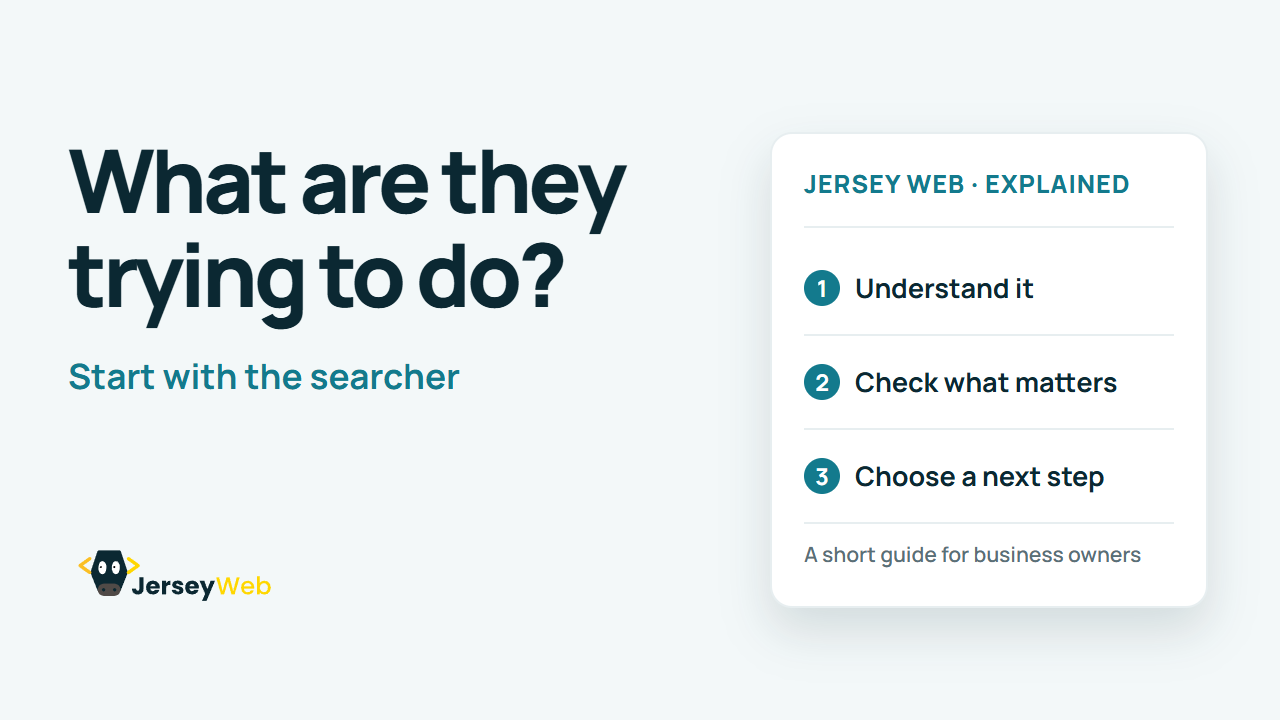
Search intent is what someone is trying to achieve by making a search. Think of a person entering a shop: one visitor wants directions, another wants to compare products and another is ready to pay. Offering every visitor the same sales pitch misses those different needs. The wording of a search is a clue to the task, but it is not always a complete explanation.
A person searching “what is web hosting” probably needs a definition. Someone comparing hosting packages needs information about responsibilities, costs and trade-offs. Someone seeking a named supplier may want that supplier’s contact page. The same subject can therefore call for several kinds of useful content without requiring several nearly identical pages.
Labels such as informational, navigational, commercial and transactional are planning shorthand. They are not rigid boxes that every person obeys. A visitor may start with an explanation and then request help. The page should answer the immediate question clearly and make the next relevant step available without hiding the answer behind a sales form.
Why it matters for a Jersey business
Island searches often combine a service with a location. The customer may want to know whether the business serves their parish, whether it is open or whether a certain job is available. A long article about the history of the service can be well written yet fail to answer that immediate practical need.
Other searches need local explanation rather than a commercial offer. A question about a .je domain or Jersey’s data protection regime needs accurate context. Google’s helpful-content guidance asks whether the content helps the intended audience achieve its goal. That is a useful editorial test even before considering rankings.
A Jersey example
Imagine a hypothetical business owner searching for the difference between a .je domain and hosting. A page demanding an immediate purchase is unlikely to resolve the confusion. A plain-English explanation can show what each service does, then link to suitable support.
Later, the same owner searches for help recovering access to an old domain. Now a step-by-step ownership guide may be more useful than another general definition. The site should let that person move between the explanation, recovery guidance and a relevant service without forcing them through unrelated pages.
What to do
Write down the task each important page is meant to solve. Ask what a reader should understand or be able to do after visiting it. If the answer is only “see our keywords”, the purpose needs more work. Use actual customer questions and enquiries where available, and label hypothetical examples honestly.
Inspect current relevant search results to see what kinds of pages appear, while remembering that results vary by time and context. This can help distinguish an explanation from a comparison or local service search. It is not proof of total demand, and copying competitors’ headings does not establish that their claims are correct.
Match the page’s title, opening answer and practical next step to the task. A glossary page should define its subject; a guide should help carry out the work; a service page should explain the offer and contact route. Clear internal links let readers continue without making every page perform every role at once.
Review performance and enquiries together. Search Console’s performance report can indicate the queries producing visibility, but it does not reveal every visitor’s thinking. A page receiving clicks but repeatedly generating the wrong requests may need clearer scope rather than more traffic.
Common myths
“One word has only one intent.” Context, location and additional wording can change what the person needs.
“Information pages should never link to services.” A relevant next step can be useful after the explanation, provided the answer remains accessible.
“Matching the result type guarantees success.” A suitable format still needs trustworthy information and a usable experience.
Our take
Jersey Web’s view is that a page should make its job obvious. Readers should quickly see whether it explains a term, provides practical guidance or offers help. That clarity makes content easier to use and makes later editorial decisions less dependent on guesses about a single phrase.
Related terms
Learn more
Common questions
- Is intent the same as a keyword?
- No. The phrase is the wording of the search; intent is the task behind it. Similar wording can hide different needs, so inspect the context and relevant results rather than relying on the phrase alone.
- What are common kinds of intent?
- People may want information, a particular site, a comparison or an action such as buying or booking. These are useful planning categories, but real customer needs can overlap and change.
- Can one page answer several needs?
- Yes, where the tasks fit together clearly. A service page can explain an offer and answer practical questions. If an explanation or comparison needs substantial detail, a separate useful page may make the main task clearer.
- Does matching intent guarantee a ranking?
- No. It is a useful editorial decision, not a ranking guarantee. The content still needs to be accurate, accessible and relevant, and search engines consider many other factors.
Written by Jersey Web. Last reviewed 3 October 2026. Back to the Jargon Buster.