In plain English
An AI hallucination is an answer or detail that seems reasonable but is not supported by the facts. A language model can produce fluent sentences without having established that each claim is true. The output might contain a made-up date, an incorrect service feature, an invented quotation or a source link that looks convincing but leads nowhere useful.
The term does not mean that software has a human experience. It describes a recognised error pattern in generated output. OpenAI’s explanation discusses plausible but false statements and why confidence is not the same as correctness. The practical implication for a business is simple: good writing still needs factual review.
Not every inaccurate statement has the same cause. A tool can also use outdated information, misunderstand the question or apply a rule from the wrong country. From the reader’s point of view, these distinctions do not repair an incorrect promise. The owner needs to check whether the published statement is justified and relevant to the actual service.
Why it matters for a Jersey business
Generic generated copy can quietly import assumptions that do not fit Jersey. It might describe the wrong tax regime, service area, shipping arrangement or regulatory requirement. A sentence can be well written and still cause confusion if customers rely on it to decide whether a business can deliver what they need.
Business-specific facts need review too. An AI tool does not automatically know the current opening hours, stock, qualifications or response times of a particular company. Supplying a draft brief can help, but the final copy should be checked by someone authorised to confirm those details. A source about an industry does not substantiate a promise about your business.
A realistic Jersey example
Imagine a Jersey retailer drafting a delivery FAQ with an AI tool. This is an illustrative example. The draft confidently states a delivery timetable, mentions a customs arrangement and describes a refund process that the owner never supplied. The wording reads smoothly, but those commitments need evidence from the retailer’s actual operations and current official guidance.
The owner marks each factual claim, checks the relevant original material and rewrites uncertain wording. The final FAQ distinguishes the business’s confirmed process from information a customer needs to check for their destination. The useful result comes from review, rather than publishing the first polished draft.
A practical checking workflow
Identify the claims that matter. Highlight dates, prices, rules, names, product capabilities and customer promises. Ask which statements come from an approved business record, which come from an external source and which are merely suggestions. This separates facts that can be verified from creative wording that can be judged editorially.
Open each cited source. Confirm that it exists, is appropriate for the claim and supports the wording actually used. A real webpage can still be a poor citation when it discusses another product, an old version or a different jurisdiction. Check the date and scope where they affect the statement.
Review business facts with the responsible person. Confirm availability, service areas and any commitments about refunds, timescales or support. Keep sensitive customer information out of unnecessary drafting inputs. Decide who can approve the copy and retain a concise review record for material that may need future updates.
Read the final page as a customer. Is it clear what the company offers and what remains conditional? Google’s helpful-content guidance encourages useful, reliable material created for readers. The goal is a page that answers the question accurately, rather than a large quantity of apparently authoritative text.
Common myths
A source link proves the answer was checked. The source must exist and support the associated claim.
A better prompt guarantees truthful output. Clear instructions can help, but they do not remove the need for verification.
A professional tone means professional evidence. Style and factual support are different qualities.
Our take
Jersey Web’s view is to use AI drafts within an accountable review process. Keep the useful organisation and wording, verify claims that customers may rely on and remove details that cannot be substantiated. That is a practical way to improve copy while keeping business responsibility clear.
See it in a diagram
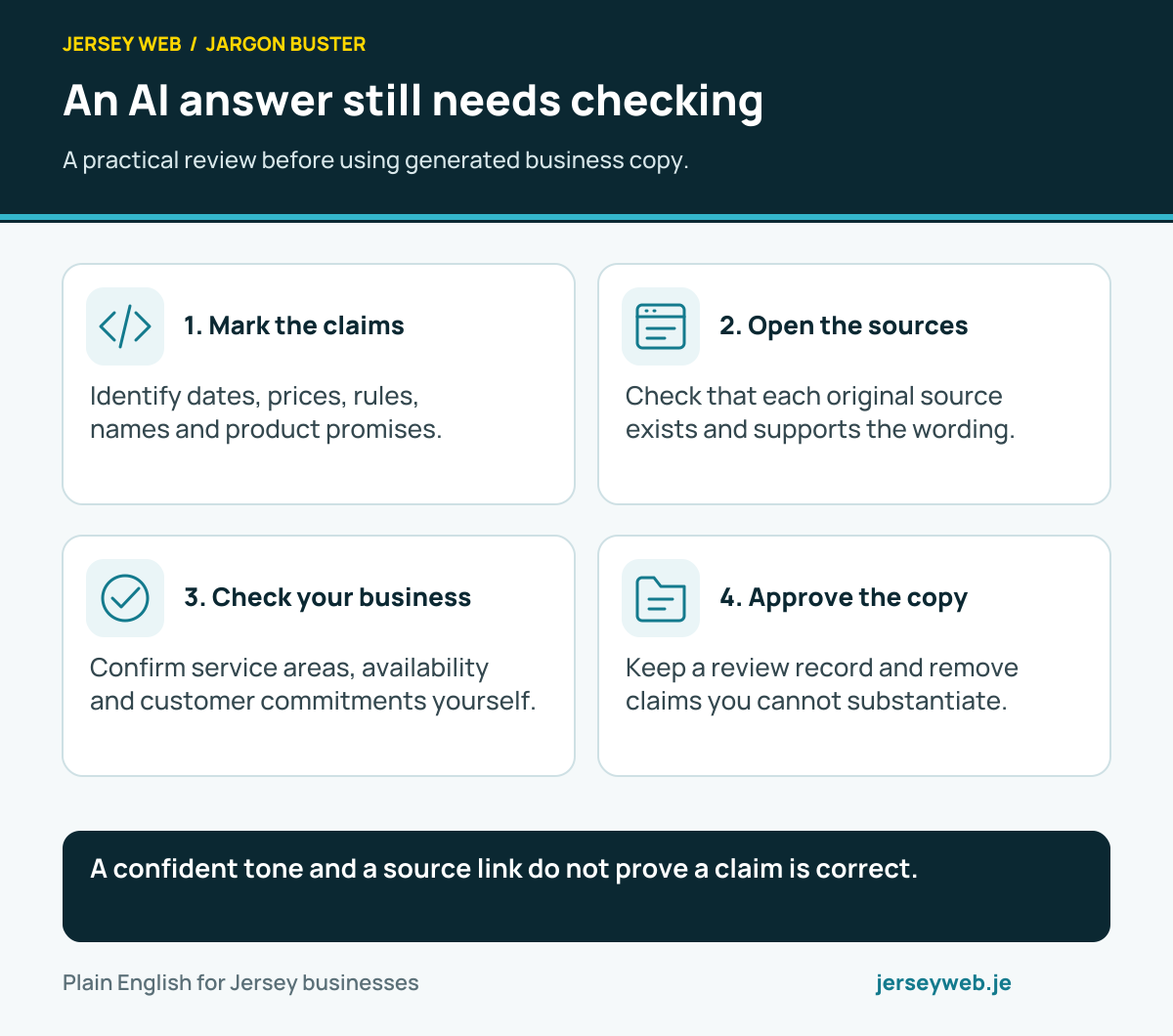
A confident tone and a source link do not prove a claim is correct.
Read the diagram in text
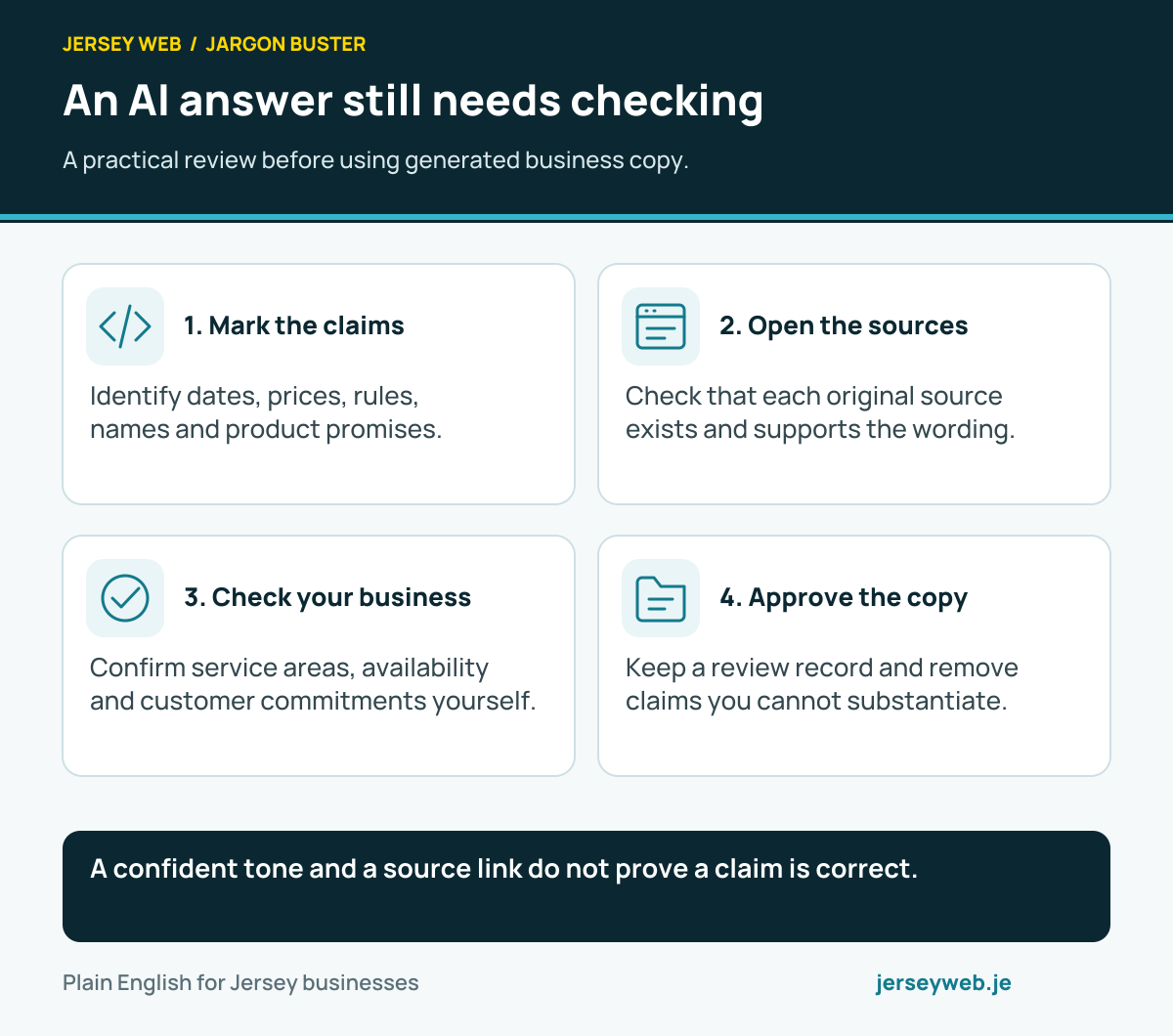
- Mark the claims. Identify dates, prices, rules, names and product promises.
- Open the sources. Check that each original source exists and supports the wording.
- Check your business. Confirm service areas, availability and customer commitments yourself.
- Approve the copy. Keep a review record and remove claims you cannot substantiate.
Related terms
Learn more
Common questions
- Does a confident AI answer mean it is correct?
- No. Fluent wording and confidence are not verification. Check the underlying claim, especially dates, rules, prices, names and commitments that affect customers.
- Can an AI tool invent a source?
- Yes. A generated source title or URL can be incorrect or fail to support the associated claim. Open the original source and check the relevant passage.
- Does browsing remove every hallucination?
- No. Access to sources can help, but the system can still select unsuitable material, misread it or make unsupported inferences. Review both the source and the resulting wording.
- Should I stop using AI for drafting?
- AI can still help organise ideas and draft text. Treat generated wording as material to review, with a clear owner responsible for facts and final customer-facing promises.
Written by Jersey Web. Last reviewed 3 October 2026. Back to the Jargon Buster.