Watch a related explainer
In plain English
Ecommerce is the process of selling online. A customer can discover a product or service, decide whether it suits them, place an order and usually pay through a website or linked checkout. The website is the shopfront; the business still has to prepare what happens behind the counter: stock, delivery, confirmation messages, support and returns.
An online shop commonly has product or service pages, a basket, checkout and a way to manage orders. A smaller business might use a payment link or booking tool instead of a full shop. For example, Stripe’s Checkout documentation describes both a hosted payment page and forms embedded in a site. Those tools handle payment collection, but they do not write accurate product descriptions or decide how a parcel reaches a customer.
Think of ecommerce as the whole order journey, not merely the payment button. A completed card charge is only one stage. The customer also needs to know what they ordered, the total cost, when to expect it and whom to contact if something goes wrong.
Why it matters to a Jersey business
Jersey creates practical questions that a generic shop template may miss. Can the business deliver to every parish? Can it ship to Guernsey, the UK or farther afield? Does the checkout calculate shipping correctly for each destination? Are collection times stated clearly? These choices affect whether a customer can complete an order confidently.
Tax and selling rules deserve attention before launch. The Government of Jersey’s selling rules say distance sales over the internet fall under the Distance Selling (Jersey) Law 2007. Revenue Jersey’s GST guidance explains when a Jersey business must register and makes clear that a business which is not registered must not charge GST. Overseas sales can raise separate issues. Configure the shop from the business’s actual tax position instead of copying settings from a UK template.
Orders also contain personal information. Names, addresses and contact details need secure handling and a privacy notice that describes the real process. The Data Protection (Jersey) Law 2018 applies to relevant personal data processing. A payment provider does not remove the seller’s own responsibilities for order records and customer communication.
A Jersey example
Imagine a Jersey maker selling ceramics. The shop shows each item’s size, price and stock status. At checkout, a customer chooses local collection or delivery. The business states which destinations it serves and whether fragile items have a different delivery method. After payment, the customer receives an order confirmation and knows how to ask about a damaged item.
This is a hypothetical example. The maker would need to verify the tax and consumer information for its actual products and customers. A clear checkout can prevent confusion, but it cannot replace an accurate stock record or a reliable packing and dispatch process.
What to do
Map one order from beginning to end before choosing software. What does the customer need to know on the product page? Which payment methods will you offer? How do stock, collection slots and shipping charges update? What happens if payment succeeds but the confirmation email fails? Who handles a refund? Test these questions on a phone with a small real order before inviting customers in.
Keep the first version focused. A small, accurate catalogue with clear photos and delivery terms is easier to maintain than a large one full of out-of-stock items. Make important policies visible before checkout, use a secure payment route and do not ask for information you do not need. Our guide to selling online from Jersey covers the broader launch decisions; the online shop service covers the build.
Common myths
Adding a payment button makes a complete shop. Order confirmation, fulfilment, support and returns still need processes.
A platform’s default tax settings must suit Jersey. Check GST registration, the supply and the destination against current guidance before setting rates.
An online shop needs hundreds of products. A focused range can work when the information and fulfilment are reliable.
Our take
Jersey Web’s view is to design the order process before choosing the visual template. Clear stock, delivery, tax and support information make a checkout easier to trust. The best first release is one the business can operate accurately every day.
See it in a diagram
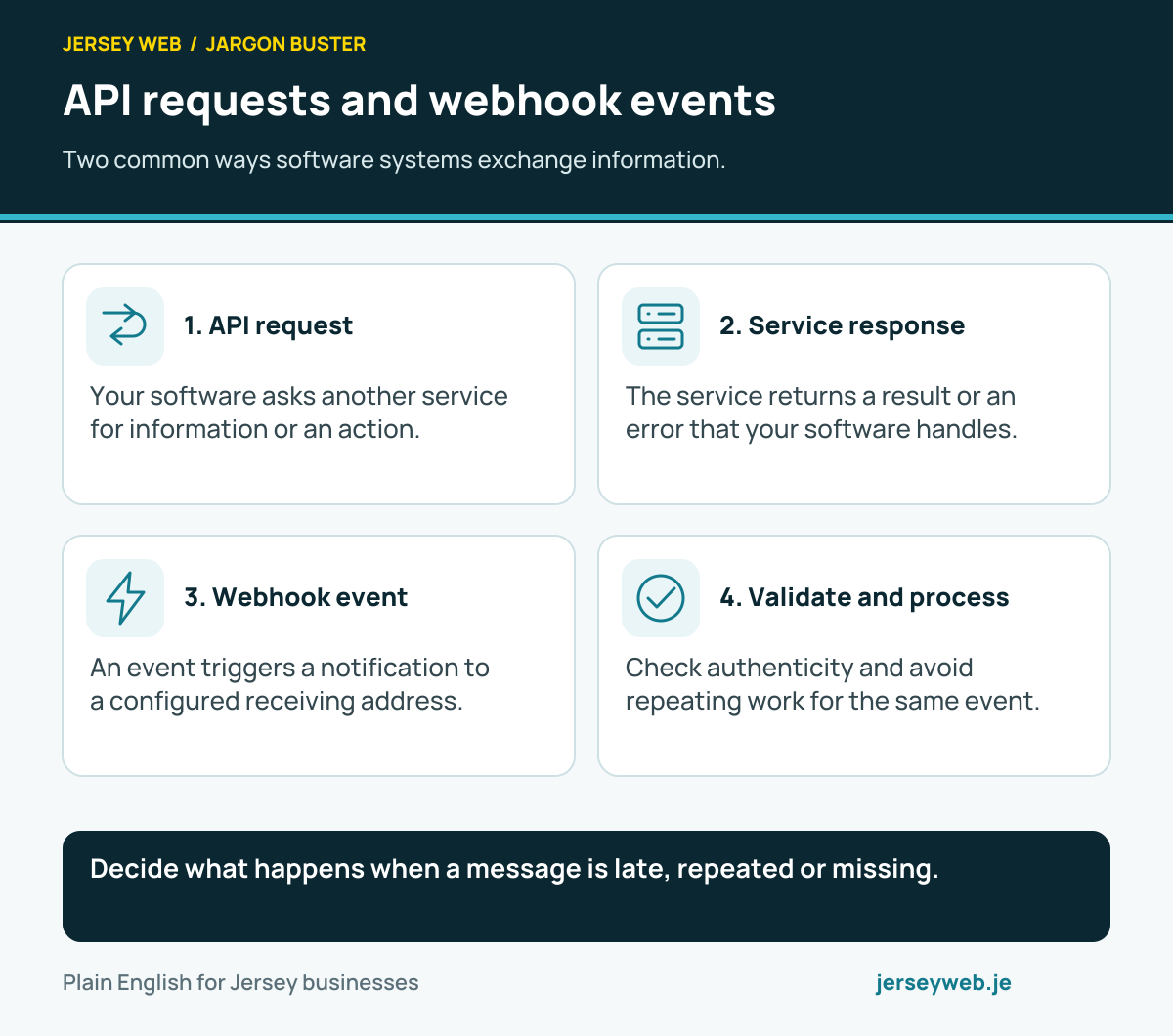
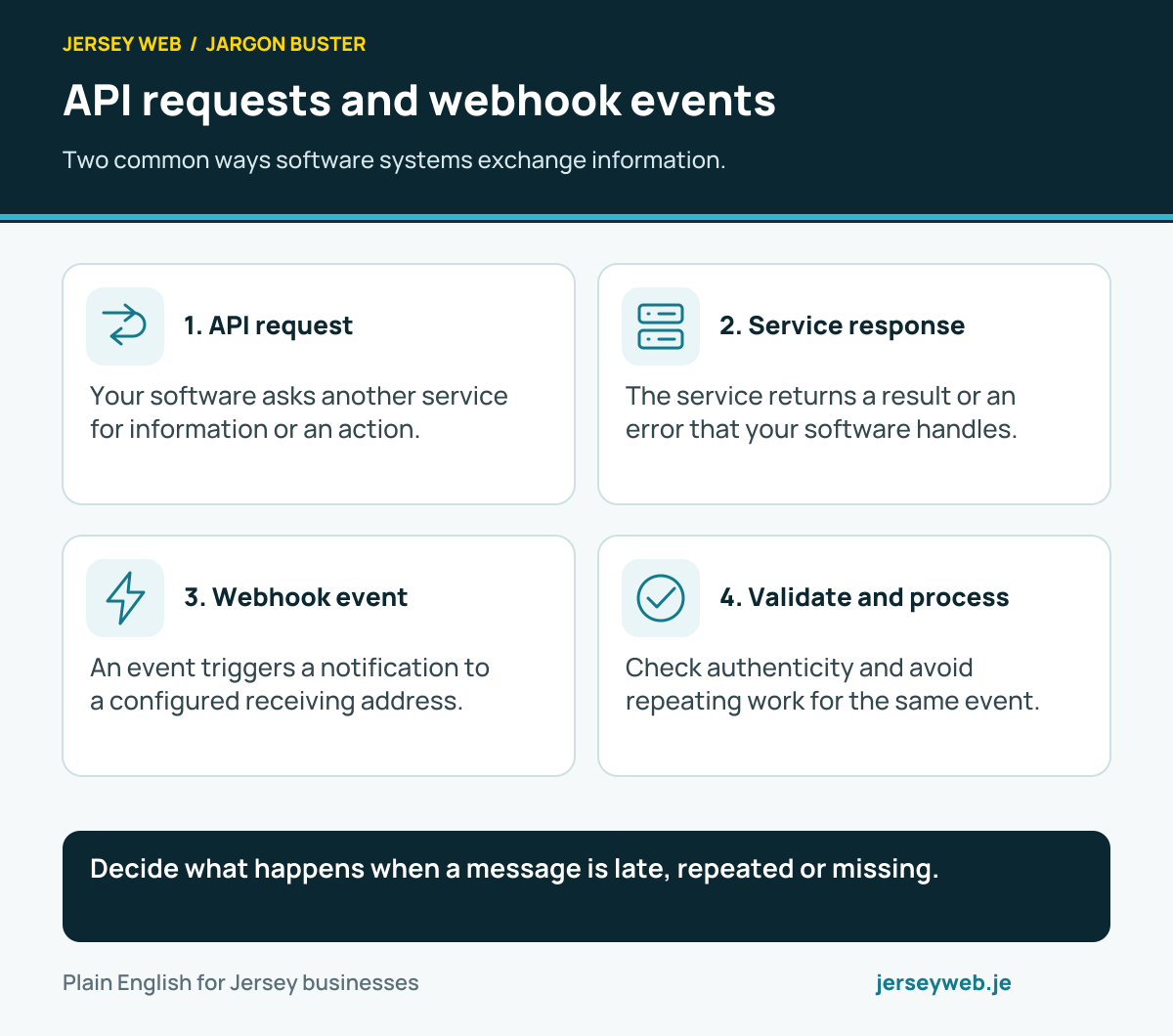
Decide what happens when a message is late, repeated or missing.
Read the diagram in text
- API request. Your software asks another service for information or an action.
- Service response. The service returns a result or an error that your software handles.
- Webhook event. An event triggers a notification to a configured receiving address.
- Validate and process. Check authenticity and avoid repeating work for the same event.
Related terms
Learn more
Common questions
- Is ecommerce only for physical products?
- No. Online selling can include services, bookings and digital products as well as physical goods. The checkout and fulfilment needs depend on what the customer is buying.
- Do I need an online shop to take payments?
- Not always. Some businesses use a hosted payment link or booking system. A full shop helps when customers need to browse items, manage a basket or choose delivery options.
- Does a payment provider handle the whole order?
- No. It handles the payment part. The business still needs to manage product information, fulfilment, customer questions, refunds and its own legal and tax duties.
- Does a Jersey online shop always charge GST?
- No. GST treatment depends on registration status and the type and place of supply. Check current Revenue Jersey guidance for the business and destination before setting tax rules in a checkout.
Written by Jersey Web. Last reviewed 3 October 2026. Back to the Jargon Buster.