In plain English
ROAS stands for return on advertising spend. It relates a selected advertising-attributed value to the advertising cost. A report might use sales revenue, while another arrangement uses configured conversion values. The label is only useful when the business understands what those values represent and which costs and interactions are included.
Google Ads’ conversion-value-per-cost definition describes dividing conversion value by cost. A ratio of four can be expressed as 4:1 or 400%. Those representations describe the same calculation. They do not turn the numerator into profit or establish that all of the business’s operating costs were included.
Conversion-value guidance distinguishes values that can be associated with individual transactions from an assigned common value. A number in the report therefore needs its own explanation. Ask whether it represents an observed transaction amount, a useful estimate or another configured business measure.
Why it matters for a Jersey business
A retailer may compare advertising reports with its order records, while a service business may assign values to lead actions. These arrangements answer different questions. An estimated value attached to a submitted form should not be described as money already received from a completed job. Review the progression from measured action to genuine business outcome.
Profit also requires a wider view of costs. Product supply, delivery, payment handling and staff time may matter to the business even when they are outside the advertising-cost denominator. Use the actual accounting arrangement and appropriate advice for financial decisions. This glossary explains the reporting concept without prescribing a profitable threshold for an individual business.
A realistic Jersey example
Imagine a Jersey shop reviewing a report with £800 of attributed conversion value and £200 of advertising cost. This is a hypothetical calculation, not a real customer result. Dividing £800 by £200 gives a ratio of four, or 400%. The owner records which period and value definition the calculation uses.
The team then checks the relevant orders and how the recorded amounts were supplied. Product costs and other expenses are considered separately through the business’s normal financial process. If the numerator used estimated lead values instead, the explanation would say so. The arithmetic does not prove £800 was collected or that the shop made £600 of profit.
Practical return-report checks
Define the numerator. Identify the conversion actions and values included. Check how each amount is transmitted or assigned, and whether repeated events can duplicate it. For transaction-based values, review the relevant order mapping and correction arrangement. For estimated values, document the basis clearly enough that a future report reader understands the assumption.
Align the scope. Use value and advertising cost for the same intended campaigns, reporting period and currency arrangement. Additional conversion-value settings describe relevant currency and reporting responsibilities. A technically calculated ratio can still mislead if the amounts refer to different scopes or are interpreted using inconsistent currency assumptions.
Review attribution. Google Analytics’ attribution introduction explains assigning credit across measured interactions. Credit assignment is a reporting model, rather than a direct reconstruction of every reason the customer purchased. Identify the model and relevant conversion window when comparing reports, particularly across different platforms or settings.
Check the underlying outcomes. Follow representative measured purchases or lead actions to the relevant receiving records using an appropriate authorised review. Confirm that the recorded action matches the intended definition. A high value-to-cost ratio based on the wrong event or a repeated value is not useful evidence simply because the dashboard presents it neatly.
Distinguish observed results from targets. An advertising system may use value-based bidding and a target ROAS setting. That is a campaign configuration, not a guarantee of a particular outcome. The maintainer should explain the current setup and supporting data. Avoid turning a glossary calculation into an instruction to increase spend without reviewing the actual arrangement.
Keep business interpretation separate. Record which expenses are outside the report, how returns or cancellations are handled and any important measurement limitation. Review the actual financial result through the business’s normal process. If advertising cost is zero in the selected scope, do not invent a finite ratio by dividing by zero.
Common myths
ROAS is not automatically profit, and an assigned conversion value is not necessarily collected revenue. A higher reported ratio also does not prove that attribution or event implementation is correct. Finally, a target is separate from the measured result. The definition and quality of the underlying data remain central.
Our take
Make the value-to-cost relationship explicit before interpreting the result. Verify values, scope and attribution, then consider the business’s real costs and outcomes separately. That produces a useful reporting discussion for a Jersey owner without promising a universal return threshold or a guaranteed advertising result.
See it in a diagram
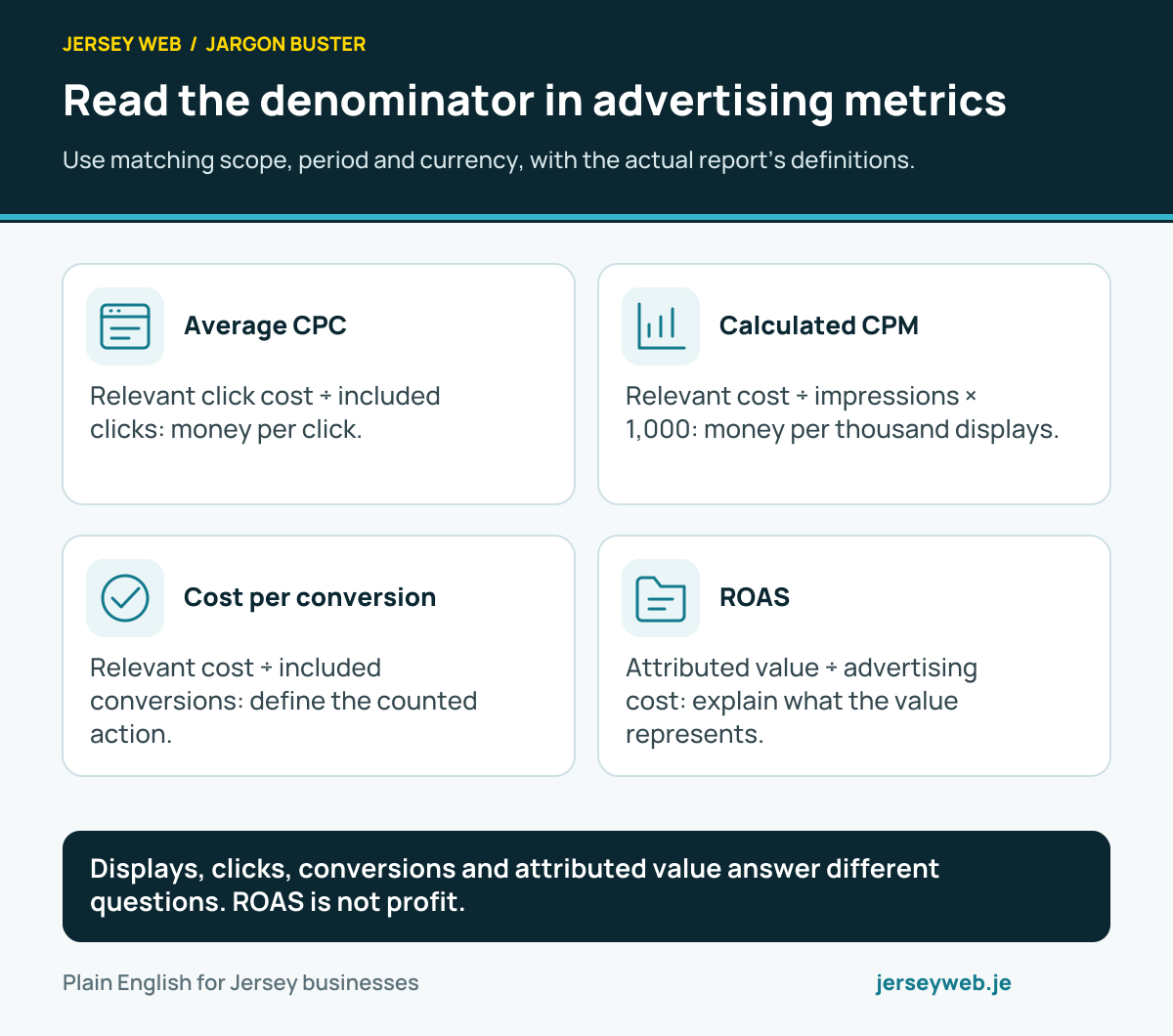
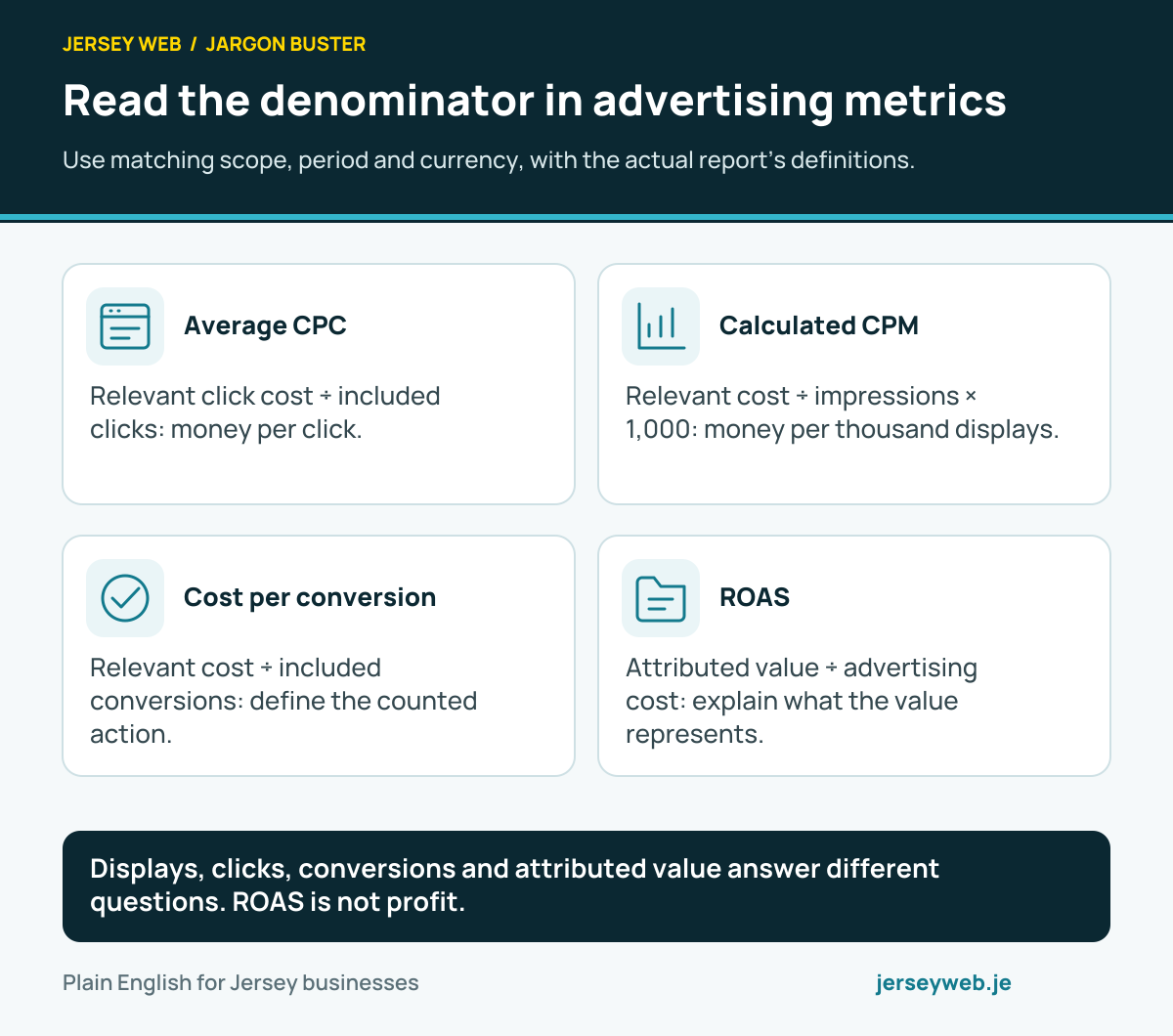
Displays, clicks, conversions and attributed value answer different questions. ROAS is not profit.
Read the diagram in text
- Average CPC. Relevant click cost ÷ included clicks: money per click.
- Calculated CPM. Relevant cost ÷ impressions × 1,000: money per thousand displays.
- Cost per conversion. Relevant cost ÷ included conversions: define the counted action.
- ROAS. Attributed value ÷ advertising cost: explain what the value represents.
Related terms
Learn more
Common questions
- How do I calculate ROAS from the relevant value and cost?
- Divide the attributed value by the advertising cost in the same relevant scope. In a hypothetical example, £800 divided by £200 gives a ratio of 4, commonly expressed as 4:1 or 400%.
- Does a ROAS of 4 mean four times the spend in profit?
- No. It describes the selected value-to-advertising-cost relationship. Product, delivery, staffing and other costs may not be included, and the configured value may not represent collected revenue.
- Is there one good ROAS for every Jersey business?
- No. The meaning depends on the value definition, measurement quality, attribution and actual business costs. This glossary does not supply a universal profitable threshold or bidding recommendation.
- Does target ROAS guarantee the reported result?
- No. A bidding target and an observed reporting result have different roles. Review the provider’s actual setup and measurement requirements with the campaign maintainer rather than treat the target as a promise.
Written by Jersey Web. Last reviewed 3 October 2026. Back to the Jargon Buster.