In plain English
Marketing attribution is a method for dividing or assigning credit for an outcome among interactions. Someone might discover a business through a recommendation, later follow a social link and then return through search before enquiring. A report’s attribution model decides how to credit the interactions it can observe under its own rules.
A model can use a defined rule or a data-driven approach. Google’s attribution introduction explains these concepts. The reported credit is an interpretation of available information. It does not reveal every influence on the customer, and it does not independently prove that a particular campaign caused the outcome.
Reports can differ legitimately. A user-scoped traffic source, a session-scoped source and attribution for an important event answer different questions. Google’s scope guidance explains why settings do not affect every dimension in the same way. Read the report definition before comparing two numbers that happen to use similar channel names.
Why it matters for a Jersey business
A Jersey business may receive referrals, local recommendations and repeat visits alongside online campaigns. Some influences will be absent from website measurement. A report can help examine observed journeys, while staff enquiries and customer feedback provide other information about how people found the business.
The owner should understand the business question behind a comparison. Is the aim to describe incoming traffic, assign reporting credit to a purchase or decide where to invest? Attribution can support a discussion, but its model and measurement limits should remain visible. A credited outcome is not automatically an additional outcome that would disappear without the credited channel.
A realistic Jersey example
Imagine a Jersey accommodation provider running a newsletter and a search campaign. This is a hypothetical example. Some customers visit through the newsletter, return later and book. Different compatible reports may describe the first visit, a later session or credited booking interactions differently.
The owner checks the outcome definition and report scope before concluding that one source has stopped working. They compare the recorded journeys with booking records and available customer feedback. This avoids interpreting a change in attribution settings as if it were a sudden change in customer demand.
What to check in a report
Identify the measured outcome. A key event, an advertising conversion and an accounting sale are related concepts but not automatically identical records. Check counting, dates and any duplicate handling. A poorly implemented event cannot become reliable merely because a sophisticated attribution model is applied to it.
Review the model and eligible channels. Google Ads’ model guidance explains product-specific choices and limitations. Do not assume an old list of models remains available, or that the same model name means every report has identical settings. Record changes when they affect comparisons.
Understand measurement gaps. Visitor choices, browser conditions and journeys across devices can affect observations. Some products use modeled information under defined conditions. Google’s modeled-event explanation describes this distinction. Modeling can inform reporting, but it is not a direct observation of every otherwise missing interaction.
Compare compatible periods and ask a narrower question. If the site changed, a promotion ended or tracking was repaired, note that context. Use business records and customer information appropriately alongside analytics. Where the available sample is small, describe uncertainty instead of assigning precise commercial meaning to a modest fluctuation.
Keep the interpretation separate from the action. A decision to change a campaign may combine attributed figures, costs, lead quality and operational capacity. Recording those reasons is clearer than saying the report alone proved the decision.
Common myths
Attributed credit is proof of causation. A model assigns reporting credit within observed information and rules.
Different reports must always show the same total and channel. Scope and counting can differ.
A model repairs incorrect event collection. The underlying measurement still needs verification.
Our take
Jersey Web’s view is to keep the report question visible. Understand which action is measured, how credit is assigned and what cannot be observed. Attribution becomes more useful when it supports a clear business discussion without being asked to prove more than the data allows.
A real Jersey example
Credit a photograph according to its licence
This original Grève de Lecq photograph has an optional JerseyWeb Photography credit and a verified Pexels page. Attribution is appreciated but not required under the Pexels licence. Our separate historical archive uses Creative Commons licences with mandatory credits. Read the individual photo terms instead of applying one rule to every image.

Browse the original Jersey photo library → · Check photo usage terms
See it in a diagram
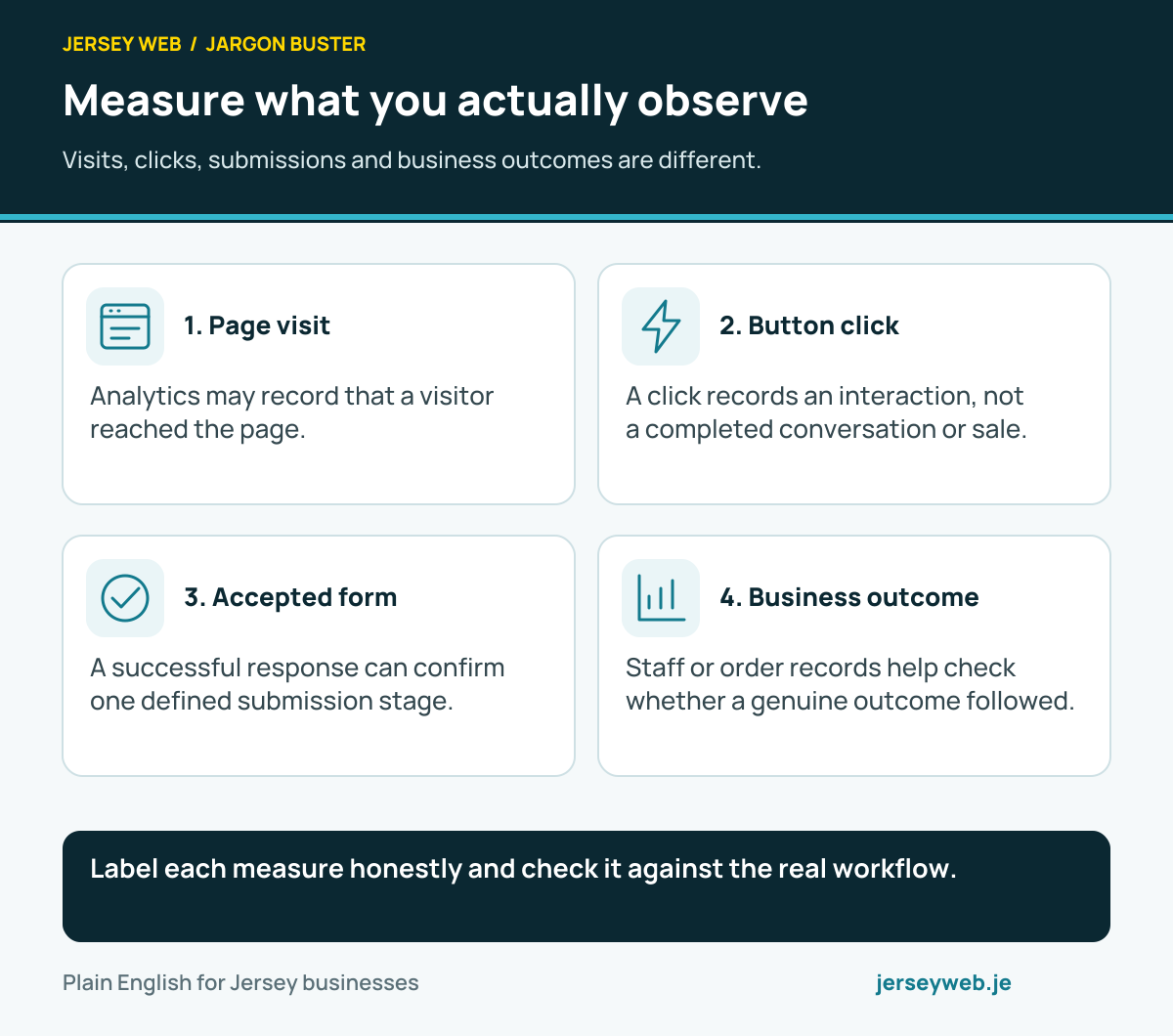
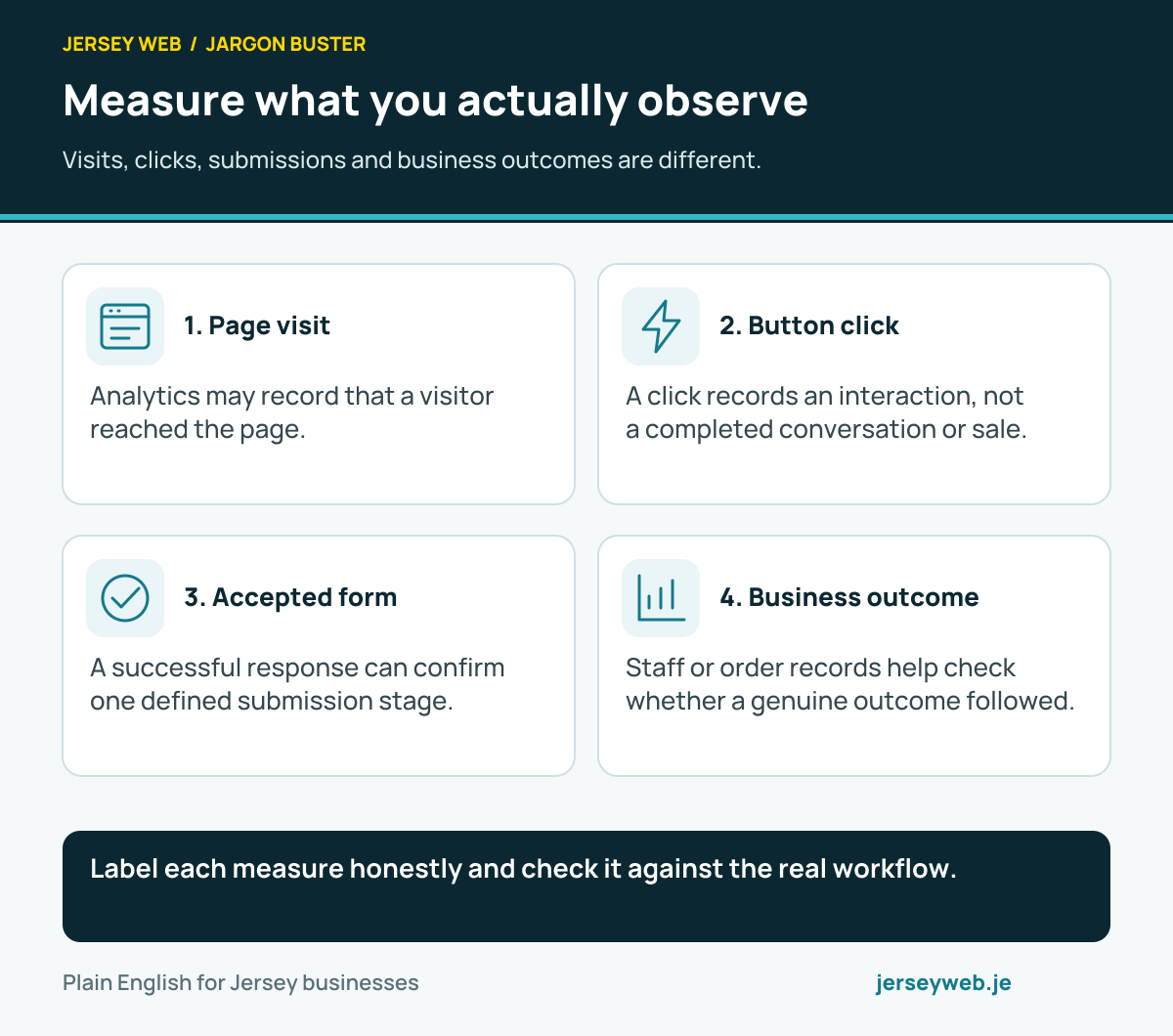
Label each measure honestly and check it against the real workflow.
Read the diagram in text
- Page visit. Analytics may record that a visitor reached the page.
- Button click. A click records an interaction, not a completed conversation or sale.
- Accepted form. A successful response can confirm one defined submission stage.
- Business outcome. Staff or order records help check whether a genuine outcome followed.
Related terms
Learn more
Common questions
- Does attribution prove why someone bought?
- No. It assigns credit using observed information and a selected model. It does not provide a complete explanation of the customer’s decision or prove the campaign caused the outcome.
- Why do two reports credit different channels?
- They may use different outcomes, counting rules, scopes, eligible channels or attribution settings. Check the report definitions before treating the figures as contradictory.
- What does last-click mean?
- A last-click model assigns credit according to its rules about the final eligible interaction. The precise treatment of channels and direct visits depends on the product and report.
- Is data-driven attribution a complete record?
- No. It applies a model to available information. Measurement limitations and product eligibility still affect the result, and modeled information should not be confused with a direct observation of every interaction.
Written by Jersey Web. Last reviewed 12 October 2026. Back to the Jargon Buster.