Watch a related explainer
In plain English
A website can make similar content available through more than one address. A product page might also be accessible with tracking parameters, or an old address might still display a copy of a newer page. Canonicalisation is the process of deciding which version should represent that content. A canonical declaration lets the website state its preferred address.
This is a preference signal, not an instruction that every search engine must follow. Google’s canonical guidance explains several signals, including declarations, redirects and sitemap inclusion. Google assesses them alongside the pages themselves and can choose a different canonical from the one the owner supplied.
A canonical is different from a redirect. A redirect moves the visitor to another address. A page with a canonical declaration may remain accessible at its current URL while naming another version as preferred. Choosing between these mechanisms depends on whether the alternate address should remain useful to visitors or has been permanently replaced.
Why it matters for a Jersey business
A Jersey business may accumulate duplicate addresses through a redesign, campaign links, platform settings or changes to page names. If the website’s navigation, sitemap and canonical declarations disagree, it becomes harder to understand which version the site intends to present. Clear signals also make reports and maintenance easier for the people responsible for the website.
The purpose is to consolidate genuine duplication, rather than force unrelated pages into one address. A plumber’s repairs page and installation page can have distinct jobs even if they share a template. Pointing every page at the homepage does not describe their content accurately and can undermine the clarity of the site’s own structure.
A realistic Jersey example
Imagine a Jersey shop launching a campaign that adds tracking information to product links. This is a hypothetical example. The product information remains the same, so the website’s preferred address is the ordinary product URL. The sitemap and internal product links also use that preferred address.
Separately, an old discontinued page has a genuinely relevant replacement. The developer reviews whether a redirect is appropriate for visitors arriving at the old address. These are different decisions: identifying a preferred duplicate and moving users from content that has been replaced. Treating them as one automatic rule would miss the visitor’s intent.
What to check on the site
Choose the preferred address for important pages. Check the HTTPS version, hostname and path format used by the site. Then review internal links and the sitemap so they point consistently to the intended URLs. The goal is a coherent set of signals that matches the actual content and visitor routes.
Inspect canonical declarations on ordinary pages and on any known duplicate versions. A template error can accidentally repeat one canonical across many different pages. Check a selection from each page type, especially after a redesign or migration. The declaration should point to an appropriate accessible version, rather than an unavailable or unrelated destination.
Use Search Console to investigate the version Google selected when information is available for your property. Google’s troubleshooting guidance explains checking declared and selected versions and looking for conflicts. A mismatch is a reason to investigate; it does not by itself identify the exact cause.
Review redirects separately. An old URL with relevant replacement content may need a redirect, while a distinct useful page should remain its own destination. Keep a small migration map when renaming or removing important pages, and verify that visitors following older links reach a sensible result.
Common myths
A canonical forces Google to index the target. It is a signal, and indexing is not guaranteed.
Canonicals replace redirects in every situation. They have different effects for visitors and different appropriate uses.
All pages should canonicalise to the homepage. Distinct useful pages need signals that represent their own content accurately.
Our take
Jersey Web’s view is to make preferred addresses part of ordinary website maintenance. Keep links, declarations and the sitemap consistent, and review the effect on actual visitor routes. That is easier to manage than adding isolated canonical tags without a clear content decision.
See it in a diagram
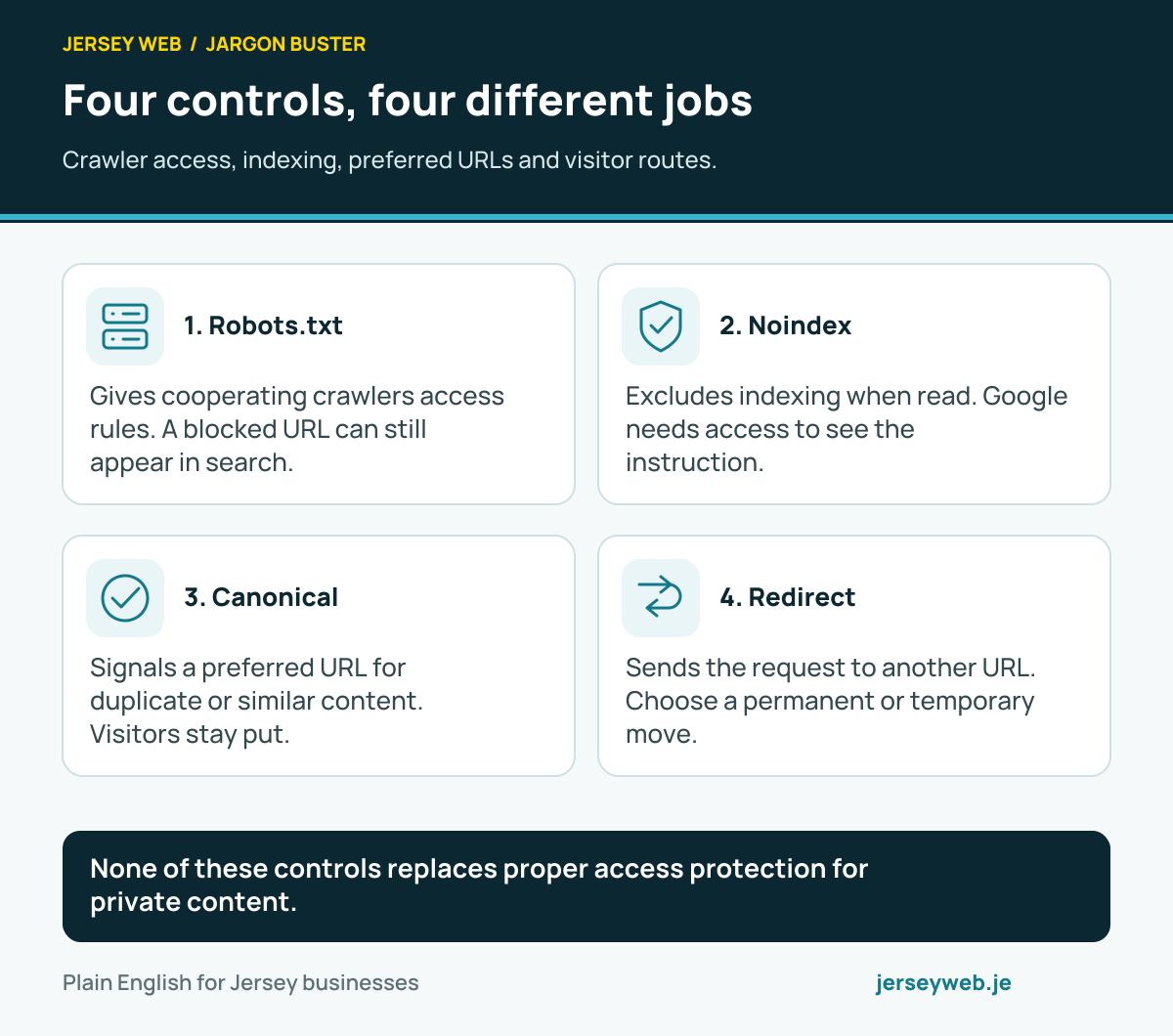
None of these controls replaces proper access protection for private content.
Read the diagram in text
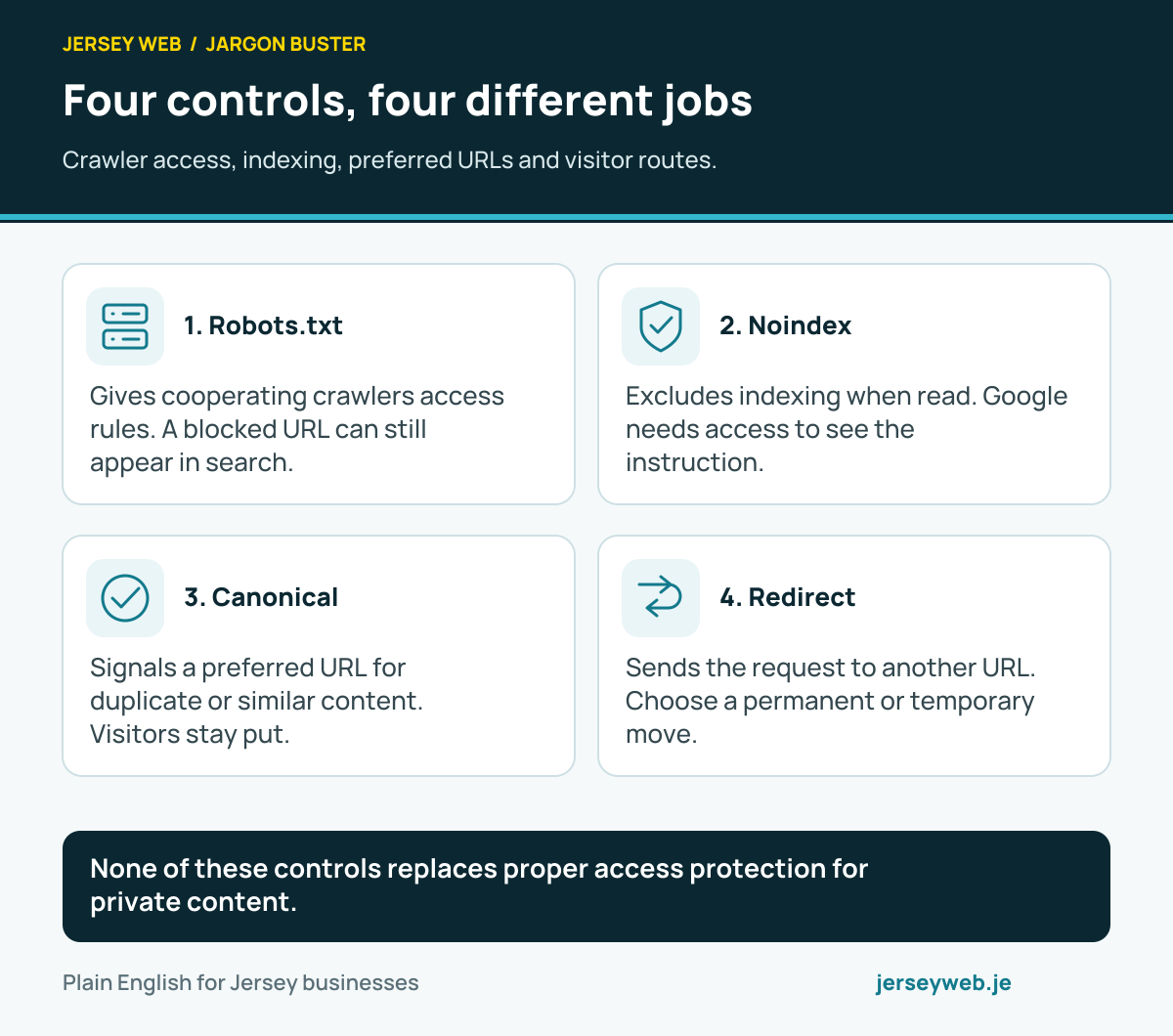
- Robots.txt. Gives cooperating crawlers access rules. A blocked URL can still appear in search.
- Noindex. Excludes indexing when read. Google needs access to see the instruction.
- Canonical. Signals a preferred URL for duplicate or similar content. Visitors stay put.
- Redirect. Sends the request to another URL. Choose a permanent or temporary move.
Related terms
Learn more
Common questions
- Does Google have to use my canonical URL?
- No. A declared preference is a signal. Google may select another version when its assessment or other signals point elsewhere.
- Is a canonical the same as a redirect?
- No. A redirect sends the visitor to another address. A canonical declaration signals a preferred version while the current page can remain accessible.
- Should every different service page point to the homepage?
- No. Canonical choices should reflect duplicate or very similar content. Distinct service pages should not be treated as copies of the homepage merely because the homepage is commercially important.
- How can I check the Google-selected canonical?
- Use Search Console’s URL Inspection information for a property you control. Compare the declared and selected versions and investigate conflicting links, redirects or declarations.
Written by Jersey Web. Last reviewed 3 October 2026. Back to the Jargon Buster.