In plain English
CPM stands for cost per thousand impressions. An impression is a recorded display according to the advertising platform’s rules. The thousand-unit convention makes the cost easier to express. A reporting ratio can be calculated by dividing the relevant cost by included impressions, then multiplying by one thousand.
Google Ads’ CPM definition describes an impression-based bidding arrangement and distinguishes viewable CPM. Read the actual label in the account: the metric being reported and the campaign’s payment arrangement are related ideas, but a calculated CPM alone does not explain every setting or charge.
Viewable CPM uses impressions meeting the relevant viewability conditions. Active View guidance explains this measurement and its limitations. Viewable means the advert met the specified condition for possible visibility. It does not establish that a particular person actually looked at the screen or remembered the business.
Why it matters for a Jersey business
A local business may want to explain an offer to an intended audience as part of an advertising campaign. CPM helps describe the cost of included display opportunities. The owner still needs to understand who the campaign aims to reach, where the advert appears and what a relevant customer should do next.
Impressions, people and outcomes are different quantities. Repeated displays can contribute several impressions without representing several new customers. A report focused on exposure should be discussed in those terms. Keep any claim about enquiries, sales or customer awareness tied to appropriate evidence rather than extending a display count beyond its definition.
A realistic Jersey example
Imagine a Jersey retailer reviewing a campaign’s reported exposure. This is a hypothetical calculation, not a real result or a market benchmark. The selected cost is £50 and the relevant impression count is 10,000. Dividing £50 by 10,000 and multiplying by 1,000 gives a calculated CPM of £5.
The owner asks whether the count refers to all included impressions or qualified viewable impressions. They also review where the advert appears and the customer’s next step. The arithmetic describes the selected cost relationship. It does not mean 10,000 unique people saw the offer, that they understood it or that the campaign returned a profit.
Practical reporting checks
Read the exact metric definition. Identify the impression type and the cost included in the selected column. Check currency, date range and relevant filters. Keep numerator and denominator aligned. If a comparison uses one account’s total impressions and another account’s viewable impressions, explain that difference before interpreting the costs as equivalent.
Distinguish bids from reported averages. Impression bidding guidance describes a maximum viewable CPM bid and how its arrangement differs from click-based bidding. Ask the campaign maintainer to explain the actual setup. A reported average summarises what happened within its scope, rather than prescribing an appropriate future bid.
Review viewability context. Check the relevant data-quality and measurability information where supplied by the platform. Not every impression necessarily has the same measurement coverage. A missing viewability result should not casually be described as either definitely seen or definitely unseen. Use the provider’s definitions and the actual report when explaining the distinction.
Inspect the advert and placement context. Verify that the offer, branding and next step are understandable in the relevant presentation. Review appropriate destination and audience settings with the person responsible for the campaign. A favourable cost ratio does not correct a misleading message, an unsuitable audience or a landing page that fails the intended customer task.
Keep outcome measures separate. If the business also wants enquiries or purchases, verify those actions through the agreed measurement and staff process. Do not rename an impression as a lead. A campaign can be reviewed against more than one purpose, but each result needs the corresponding definition and evidence.
Compare periods carefully. Record important changes in creative, audience, placements and reporting setup. Explain what is held consistent and what changed. There is no universal CPM in this glossary that establishes success for every Jersey campaign. The report should support a specific business discussion using the relevant context and observed results.
Common myths
A thousand impressions is not necessarily a thousand people. A viewable advert is not proof of attention, and a lower CPM is not automatically a better customer outcome. A calculated reporting ratio also does not describe every detail of billing. These distinctions help keep the owner’s interpretation aligned with the actual measurement.
Our take
Use CPM to describe the cost of the relevant display opportunities. Identify the impression definition and review the campaign’s purpose, presentation and outcomes alongside it. Treat viewability as a defined observation with limits, then retain the context needed to compare future reports sensibly.
See it in a diagram
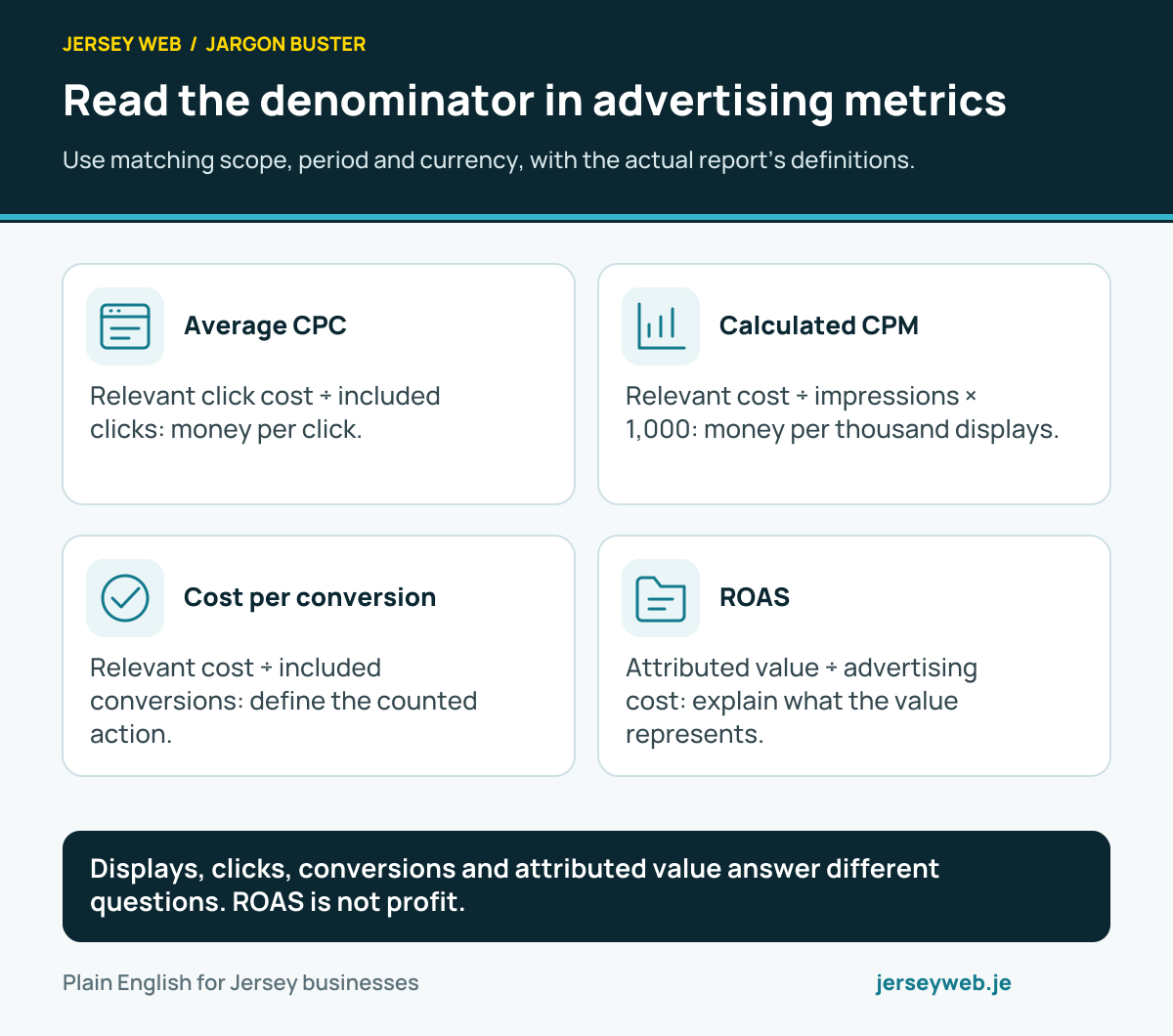
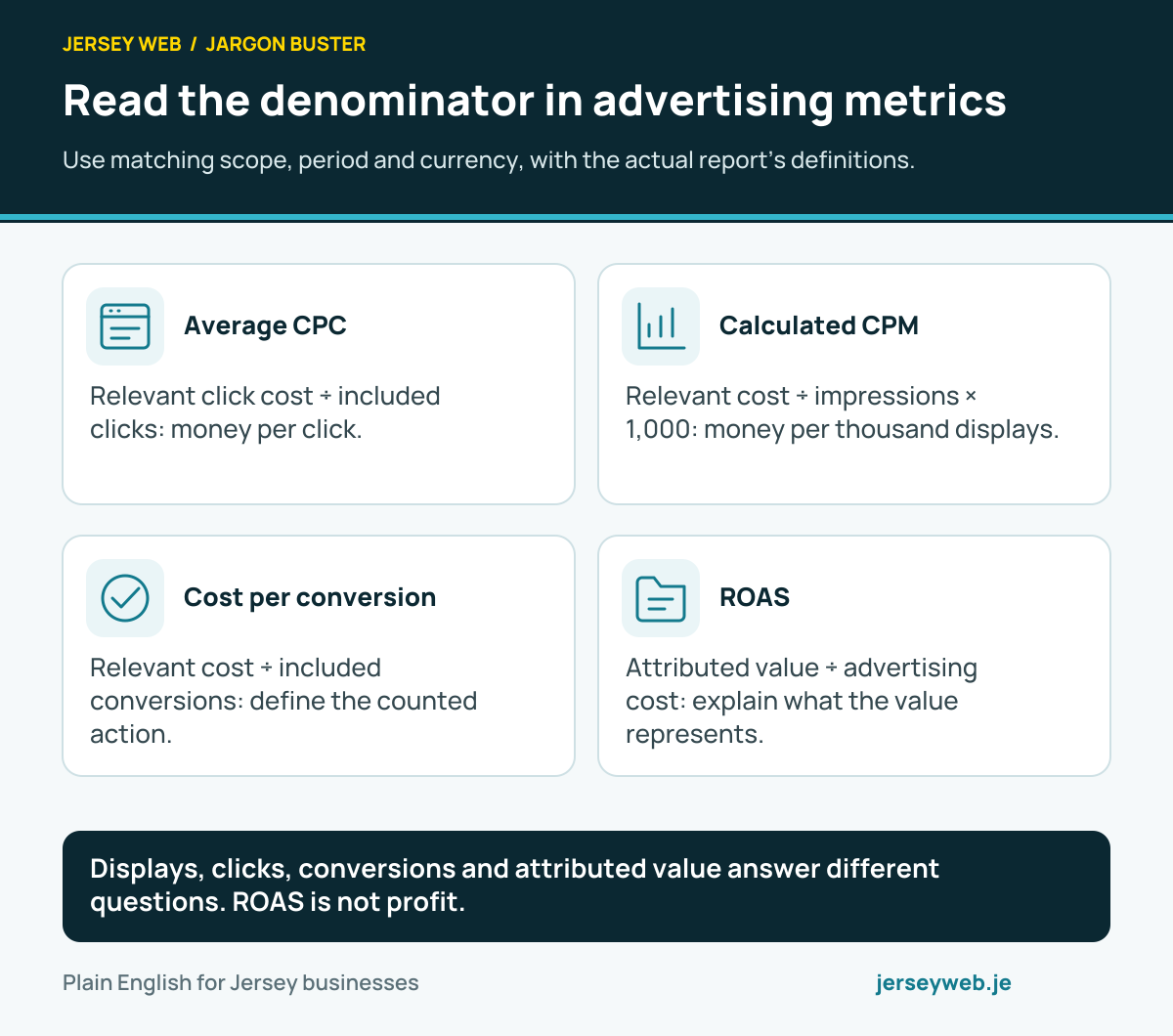
Displays, clicks, conversions and attributed value answer different questions. ROAS is not profit.
Read the diagram in text
- Average CPC. Relevant click cost ÷ included clicks: money per click.
- Calculated CPM. Relevant cost ÷ impressions × 1,000: money per thousand displays.
- Cost per conversion. Relevant cost ÷ included conversions: define the counted action.
- ROAS. Attributed value ÷ advertising cost: explain what the value represents.
Related terms
Learn more
Common questions
- How is CPM calculated as a reporting ratio?
- Divide the relevant cost by the included impressions and multiply by 1,000. A hypothetical £50 cost across 10,000 impressions gives £5 per thousand impressions. Use matching scopes and the correct impression definition.
- Does 1,000 impressions mean 1,000 different people?
- No. Impressions count relevant displays under the platform’s definition. The same person may have multiple displays, and unique reach is a different measurement.
- Does viewable mean the person read the advert?
- No. Viewability meets a defined measurement condition. It does not guarantee that a person looked at, understood or acted on the advert.
- Can I compare CPM and viewable CPM directly?
- Review their denominators and reporting definitions first. Viewable impressions are a qualified subset under the relevant arrangement, so identical-looking cost figures can describe different measurement scopes.
Written by Jersey Web. Last reviewed 3 October 2026. Back to the Jargon Buster.