Watch a related explainer
In plain English
Domain renewal maintains the registration arrangement that lets a business use its domain name. It is commonly associated with paying for a further registration period, but the exact contract and process depend on the domain ending and provider. A business should understand those arrangements before a payment becomes due.
Registration is separate from hosting and email, even when a supplier packages them together. Renewing a hosting service does not establish that the domain registration is current. Likewise, paying for a domain does not automatically provide a working website, mailbox or the DNS configuration those services need.
ICANN’s renewal and expiration guidance explains common questions within its applicable domain context. For a .je name, use the Channel Islands registry’s own rules and the registrar’s supported process. Different domain arrangements should not be treated as having identical deadlines, recovery periods or fees.
Why it matters for a Jersey business
The domain can support the public website and business email addresses. Registration problems can therefore affect more than one customer contact route. Keep the responsible provider and account owner recorded so that the business can investigate an unexpected notice or interruption promptly.
For .je domains, the registry’s registration agreement describes a continuing contract, annual fees and cancellation requirements. It also provides for suspension over unpaid fees. The owner should read the current terms and check the relevant registrar arrangement rather than assume that ignoring a bill is a cancellation instruction.
A realistic Jersey example
Imagine a Jersey trades business reviewing its .je domain during a website handover. This is a hypothetical example. The owner identifies the registrar, confirms the account and checks the current payment arrangement. The hosting supplier and email provider are listed separately, even though the original project invoice mentioned them together.
The business appoints an authorised person to review notices and registration status. It keeps a suitable contact route for account recovery and records how changes or cancellation are requested. The handover therefore establishes who is responsible without guessing a universal expiry or recovery deadline.
What to record and check
Identify the registration arrangement. Record the domain, registered business details and responsible provider. The registry’s domain-management guidance explains that names registered through an accredited registrar use that registrar’s normal procedures. Direct registrations use the registry’s account service for supported management and annual payment.
Confirm authorised access. The business should know who can manage the registrar account and how legitimate access is recovered. Keep permissions appropriate and use supported account protection. An old supplier’s login should not be the only unexplained route to a domain that supports the business’s website and email.
Review contact details. Check that relevant registration and account information is current through the genuine provider service. Notices sent to an unused address may be missed. The applicable terms determine the business’s obligations, so maintain those details according to the actual arrangement rather than an informal assumption.
Check payment and status. Review the amount and period with the actual provider, without relying on an old price or unrelated hosting invoice. Automatic payment can still require attention when a card or authority changes. Confirm the provider’s recorded outcome instead of treating a reminder being received as proof that payment succeeded.
Keep independent reminders. Record useful review dates and the person responsible for checking them. The reminder should lead to verification through the known account service. Unexpected requests for payment or account changes should be checked against the genuine provider, with credentials kept out of forwarded messages and routine notes.
Understand changes and cancellation. Ask how the registrar handles a provider move and what the registry requires for cancellation. Do not assume that cancelling web hosting cancels registration, or that a domain transfer also transfers every email and website service. Plan the related changes with the suppliers responsible for each part.
Maintain a recovery contact. Keep a documented way to reach the registrar if access, billing or registration status becomes uncertain. Explain the related service dependencies to the maintainer. Recovery possibilities depend on the specific situation and applicable rules, so investigate promptly without promising that every name can always be restored.
Common myths
Hosting payment always includes domain renewal. Check the actual package and registration record.
Every domain uses identical recovery periods. Registry and registrar arrangements differ.
Leaving a .je invoice unpaid is a clear cancellation request. Review the continuing contract and supported cancellation requirements.
Our take
Jersey Web’s view is to make domain ownership and maintenance visible in the handover. Record the provider, account responsibility and real payment arrangement, then review the specific terms. A business-critical address should have a known owner and a process that staff can verify.
See it in a diagram
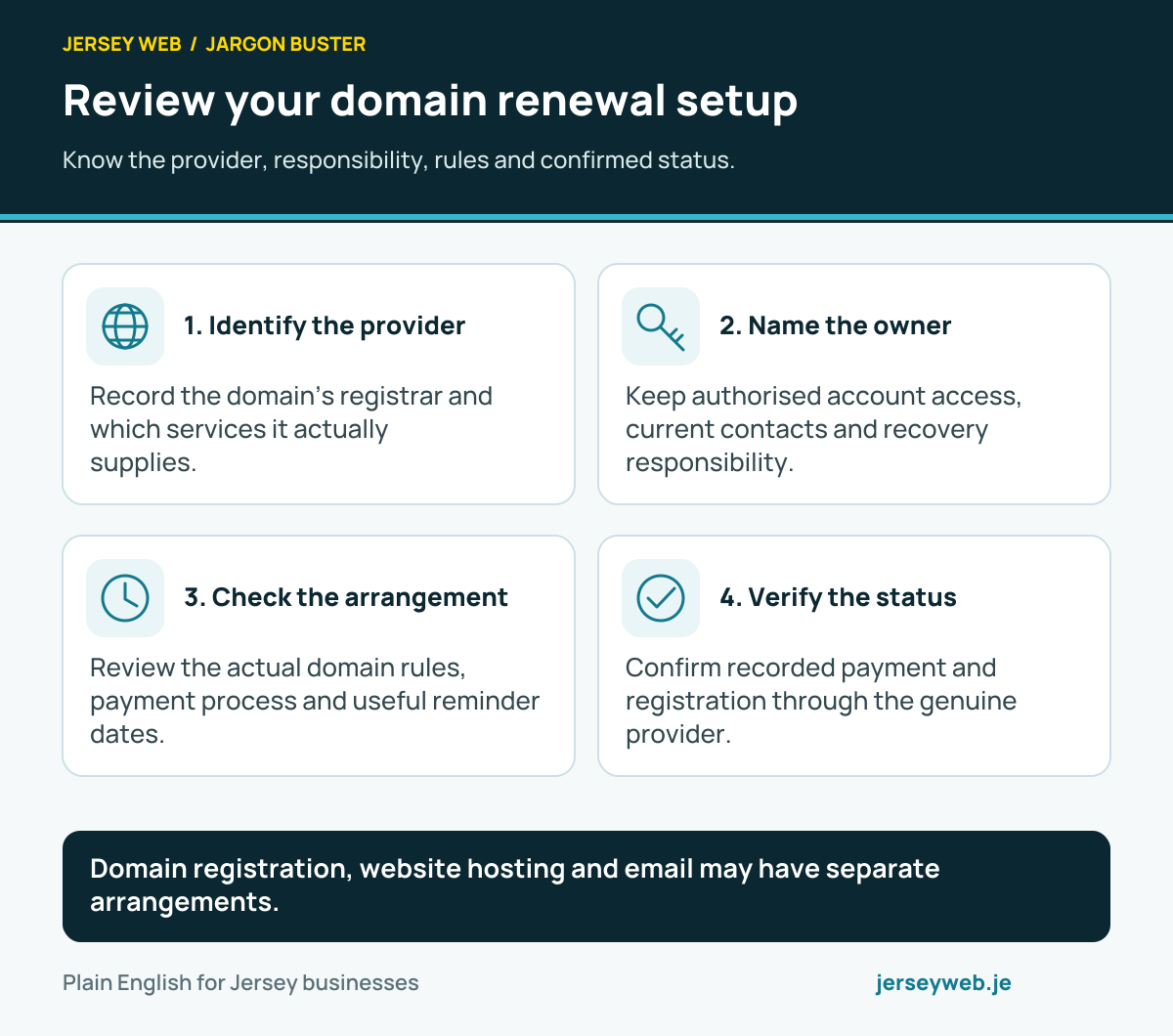
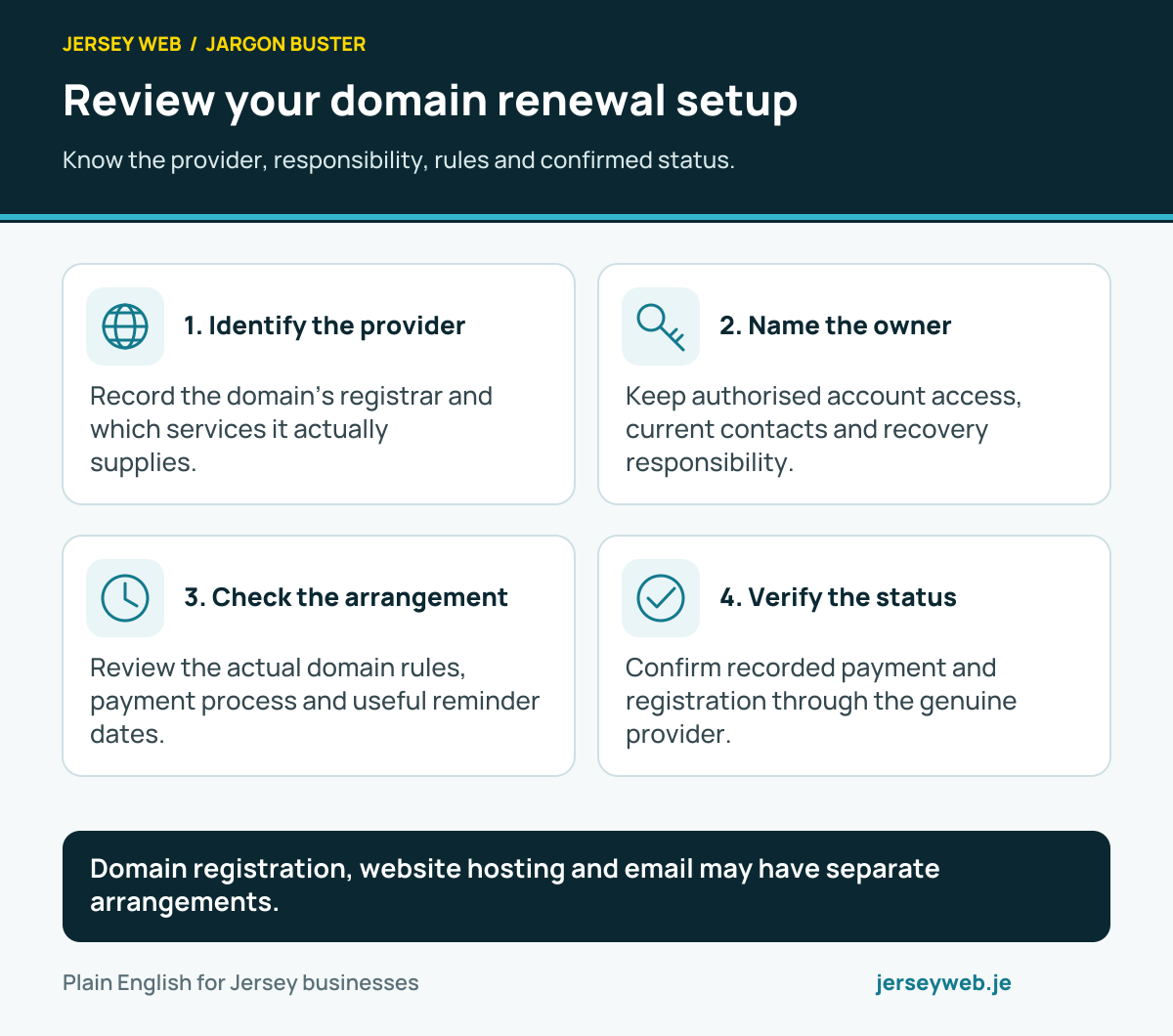
Domain registration, website hosting and email may have separate arrangements.
Read the diagram in text
- Identify the provider. Record the domain’s registrar and which services it actually supplies.
- Name the owner. Keep authorised account access, current contacts and recovery responsibility.
- Check the arrangement. Review the actual domain rules, payment process and useful reminder dates.
- Verify the status. Confirm recorded payment and registration through the genuine provider.
Related terms
Learn more
Common questions
- Does a hosting invoice always renew the domain?
- No. A package may include both services, but the business needs to verify what it covers. Registration, hosting and email can have different providers and payment arrangements.
- Do every domain ending and registrar use the same expiry rules?
- No. Check the applicable registry terms and registrar process. Do not transfer generic-domain recovery assumptions automatically to a .je registration.
- Does enabling automatic payment remove the need to check renewal?
- No. Payment details and account arrangements can change or fail. Review the provider’s confirmed registration and payment status through its genuine account service.
- Can I cancel a .je registration just by leaving an invoice unpaid?
- Do not assume that. The registry’s published agreement describes a continuing contract and cancellation requirements. Review the current terms and the registrar’s supported cancellation process.
Written by Jersey Web. Last reviewed 3 October 2026. Back to the Jargon Buster.