Watch a related explainer

In plain English
The .je part of an address such as example.je is a domain ending. It works like a signpost: a reader can recognise its Jersey connection before opening the site. The full address can direct people to a website, and it can appear after the @ in an email address. The ending is only one part of the system. Your chosen name must be registered, the DNS must be set up, and a separate service must supply the web pages or inboxes.
The Channel Islands Internet Domain Name Registry manages the .je namespace. It explains that you can register through an accredited registrar or register directly. It recommends registrars for most customers because a direct registrant has to arrange its own nameserver service. That is the service that holds the DNS settings needed to route visitors and mail. In other words, the registry can provide the name without supplying all the parts that make it useful.
A .je address can sit above many different website platforms and email providers. If you rebuild a site, the address can remain the same while its destination changes. Think of repainting or moving the shop without changing the name customers already know.
Why it matters to a Jersey business
For a business whose customers are mainly on the island, a .je ending is a quick local cue. It can fit neatly on a van, sign or receipt. It may also make an email address look consistent with a Jersey brand. It is a choice about communication, however, and it does not replace clear information on the website about where you work, how to contact you and what you do.
If you trade beyond Jersey, you may prefer .co.uk, another ending, or both. The useful question is which address customers will remember and which one you will maintain. If you register two, decide which is the main site and make the other redirect to it. Our guide to .je and .co.uk for Jersey businesses covers the wider choice. This definition page explains what the ending is and how to manage it.
The registry also distinguishes registration, nameserver service, hosting and email. That matters when comparing a web design quote. A supplier may include some of those services but not others. Ask for the name of the registrar, whose details appear as registrant and the renewal arrangements.
A Jersey example
Picture a mobile bicycle mechanic serving St Helier, St Saviour and Trinity. The owner registers islandcycles.je, uses it on the van and sets up hello@islandcycles.je. A simple website explains the service area and includes a booking form. Later, the owner changes the website provider while keeping the address and inbox. The registrar and DNS manager need to know where the new website lives, but the printed address need not change. This is an illustrative business, not a customer story.
If the owner’s email provider also asks for DNS records, those records should be documented before the website move. A careful change alters only what the new site needs, then checks that messages still arrive.
What to do
Shortlist names that are easy to say and spell. Check availability with a registrar or the registry, then compare the full renewal terms. The registry publishes its direct registration information; an individual registrar may charge differently. Avoid putting an unverified or changeable price on your printed budget until you have checked the current offer.
Register with details the business controls. Use a shared business record for the account, renewal date and contact details. If a web designer handles the purchase, ask them to confirm the registrant and how you would transfer management later. Keep access to the account even if somebody else handles DNS day to day.
Common myths
“A .je name automatically puts me above other businesses in Google.” Search visibility depends on much more than an address. Google’s SEO guide focuses on helping search engines understand useful pages, not promising a ranking from one domain ending.
“The registry will host my website if I register directly.” Direct registration does not include nameserver service, according to the registry. Web hosting is another service again.
“A designer must own the domain to work on the site.” A designer can be given the access needed to configure a site while the business keeps control of its registration.
Our take
Jersey Web’s view is to choose the address for the people who will read and remember it. Then make sure the registration sits under the business’s control. A clear renewal record and documented DNS settings are more valuable than treating the ending as a search ranking trick.
See it in a diagram
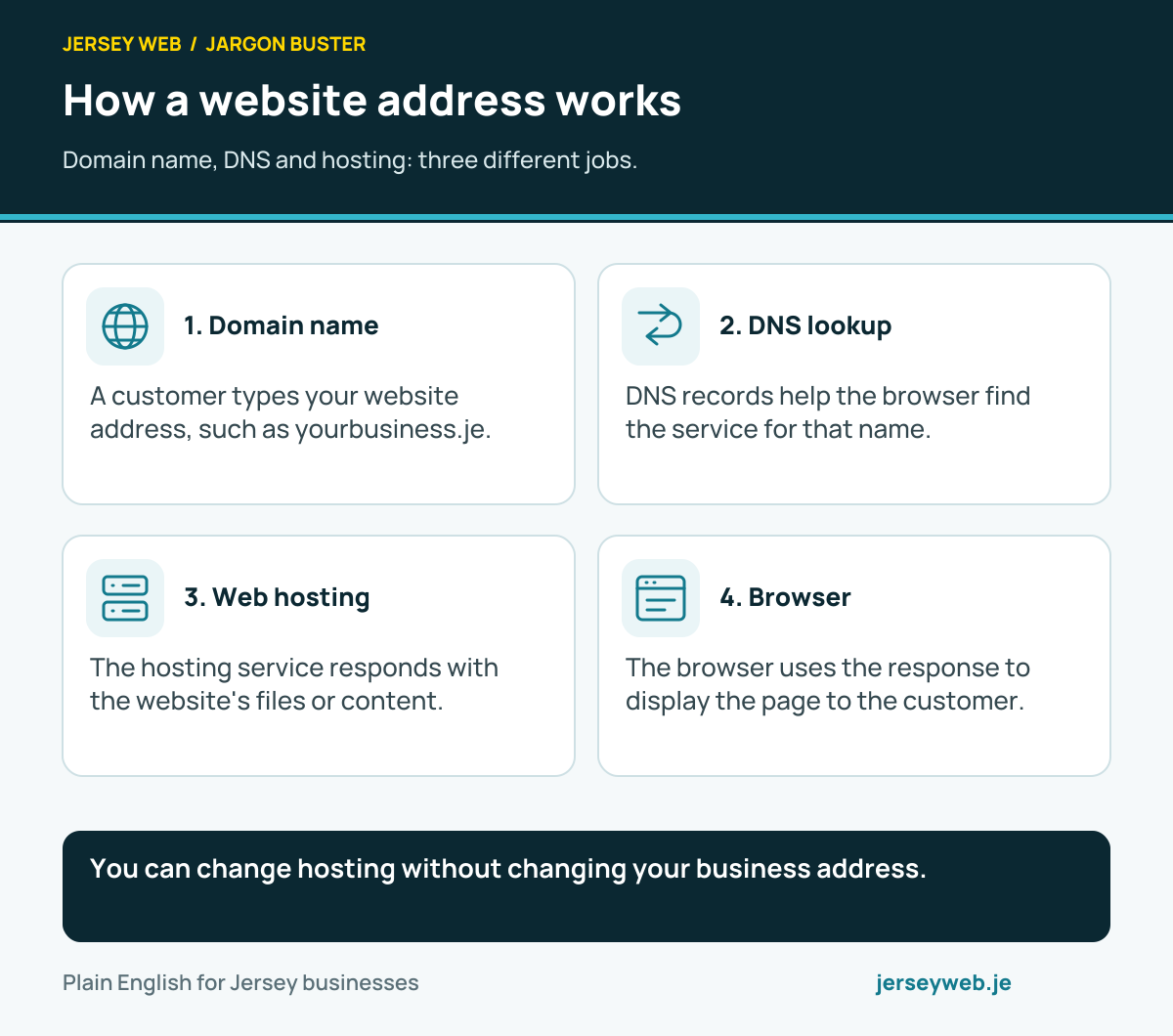
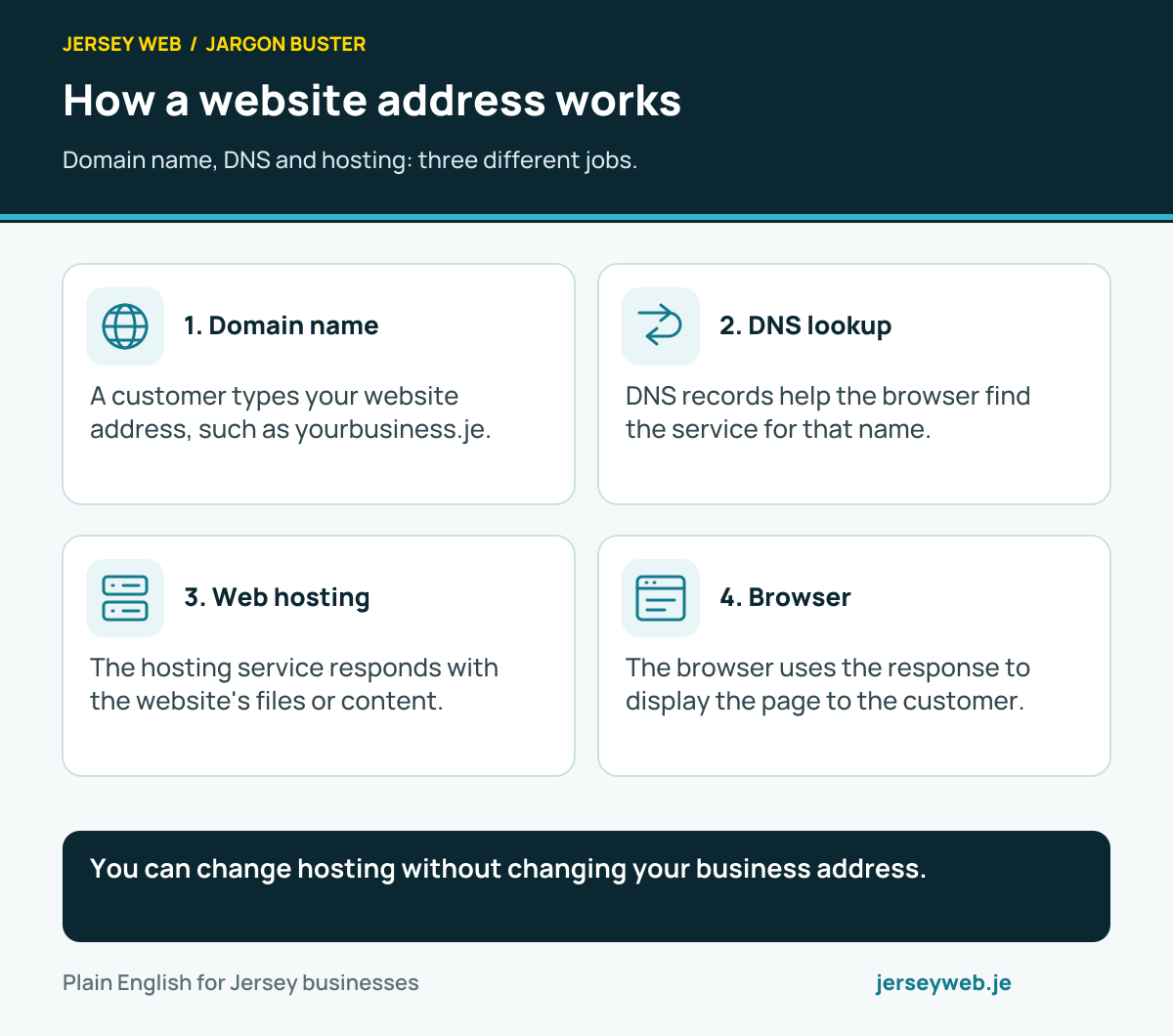
You can change hosting without changing your business address.
Read the diagram in text
- Domain name. A customer types your website address, such as yourbusiness.je.
- DNS lookup. DNS records help the browser find the service for that name.
- Web hosting. The hosting service responds with the website's files or content.
- Browser. The browser uses the response to display the page to the customer.
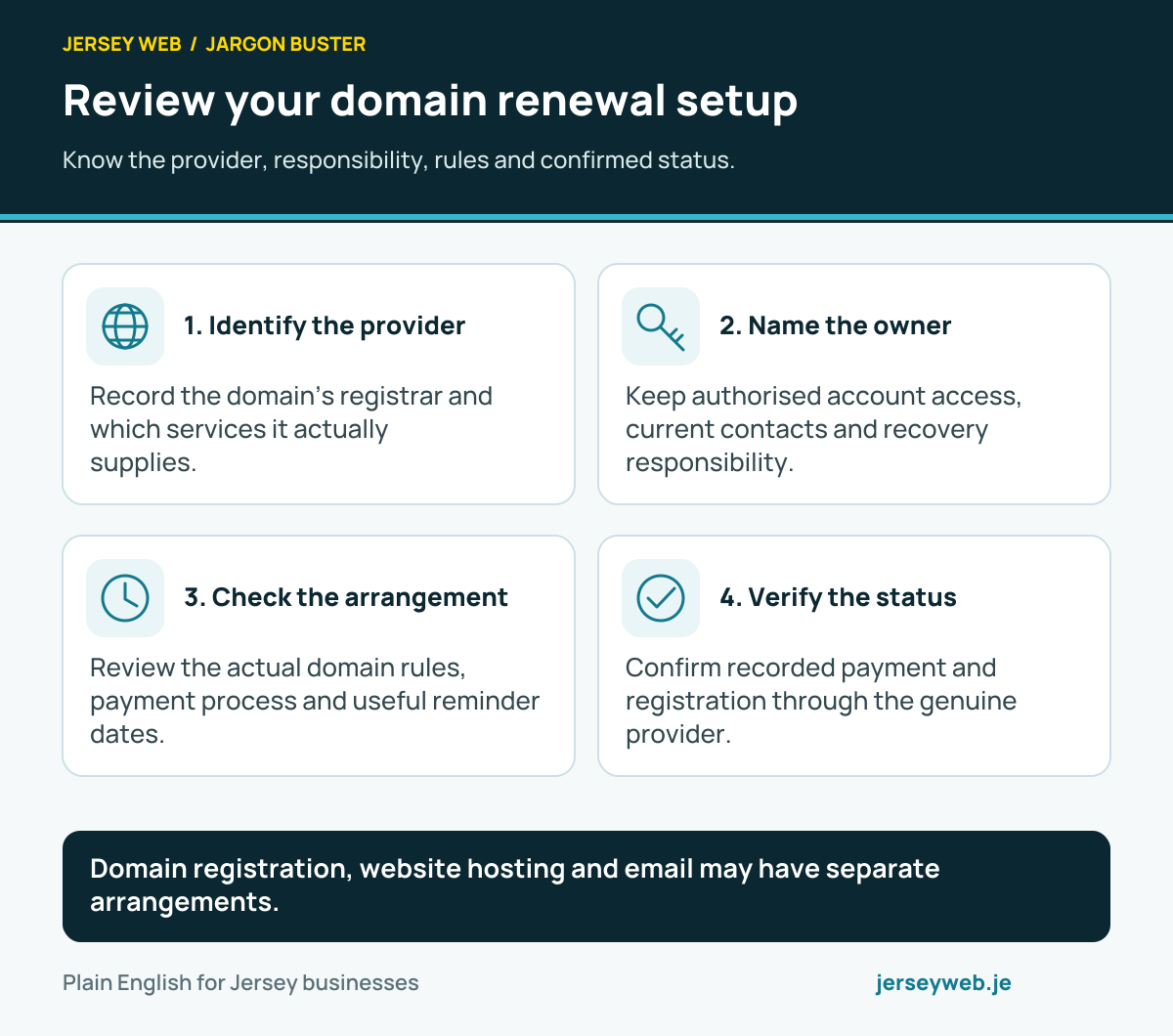
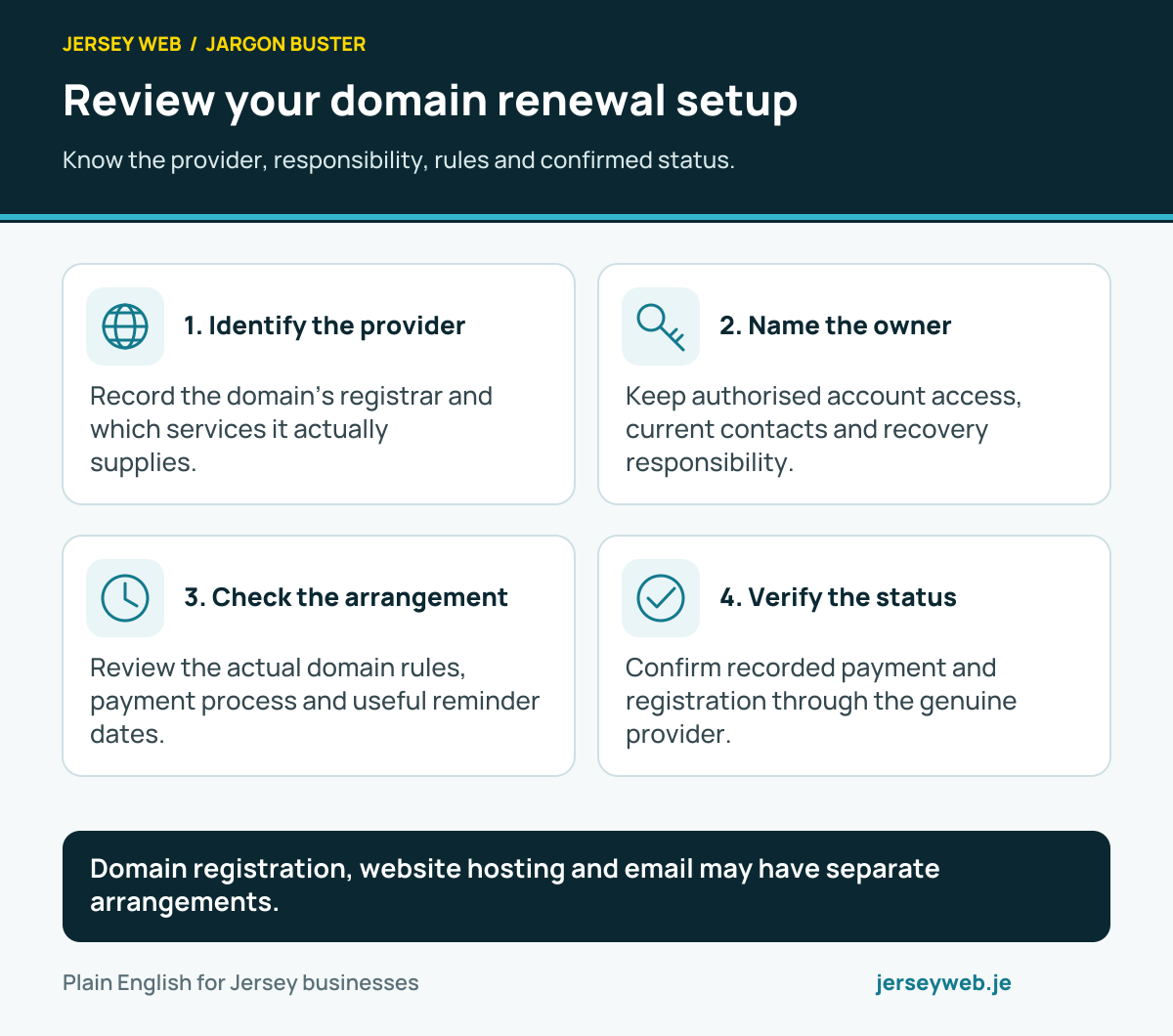
Domain registration, website hosting and email may have separate arrangements.
Read the diagram in text
- Identify the provider. Record the domain’s registrar and which services it actually supplies.
- Name the owner. Keep authorised account access, current contacts and recovery responsibility.
- Check the arrangement. Review the actual domain rules, payment process and useful reminder dates.
- Verify the status. Confirm recorded payment and registration through the genuine provider.
Related terms
Learn more
Common questions
- Does a .je domain come with a website?
- No. Registering the domain gives you an address to use under the registry's terms. You still need a website platform or host to publish pages, and an email service if you want an inbox at that address.
- Do I have to buy my .je domain directly from the registry?
- No. The Channel Islands registry recommends using an accredited registrar for most registrations and management. Direct registration is available, but the registry says you must arrange your own nameserver service.
- Is a .je domain better for Google than .co.uk?
- A domain ending alone cannot guarantee a search position. Choose an address that suits your customers and brand, then make the website useful, accessible and clear about the areas you serve.
- Can I keep my .je domain if I change web designer?
- Usually, yes. Registration and web hosting are separate. Make sure your business controls the registration, keep the renewal current and arrange any needed DNS changes when the new website is ready.
Written by Jersey Web. Last reviewed 3 October 2026. Back to the Jargon Buster.