Starting a business in Jersey: from registration to website
A few registrations come before the first customer. The video takes you through six stages in order, and the notes under it give the 2026 figures and where to apply.
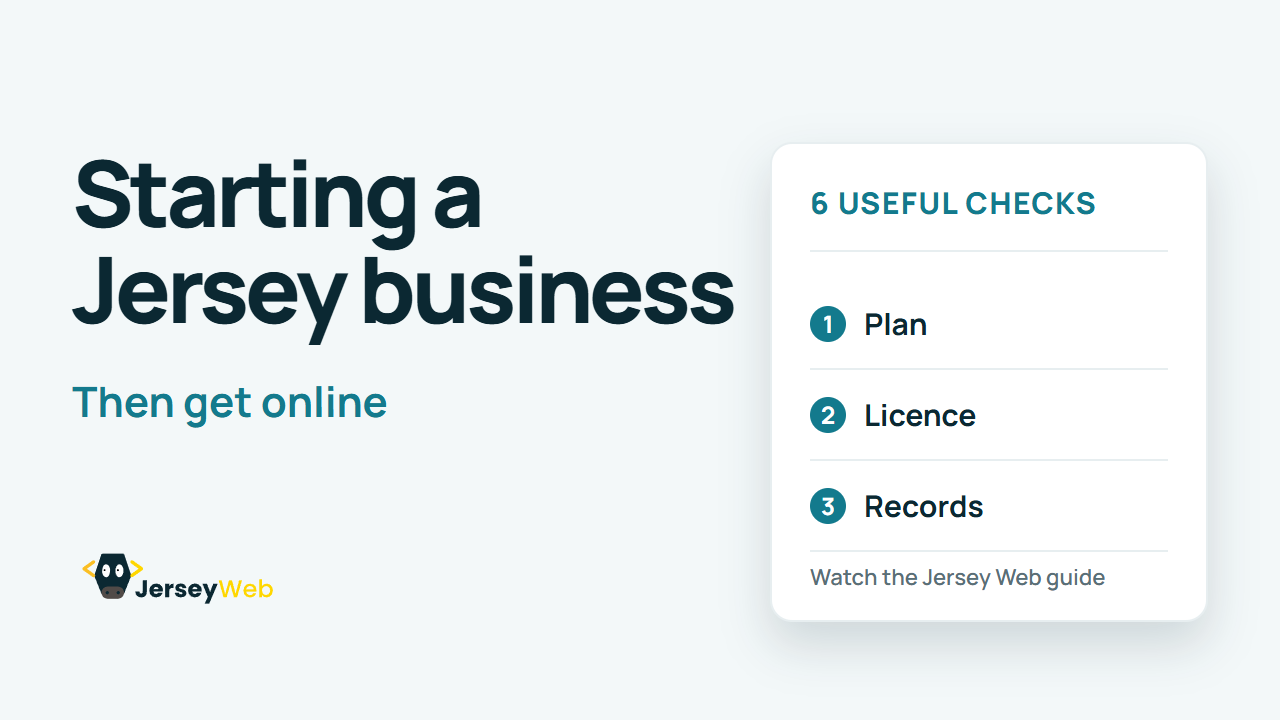
1:47 · No narration: the video shows each step as text on screen, and every step is written out below, with buttons that jump the video to it.
Prefer YouTube? Watch this video on our YouTube channel (opens in a new tab).
This video goes with our guide Starting a business in Jersey: the steps, and where your website fits, which has the full detail.
The 6 stages in the video
The video opens with a question: starting a business in Jersey? Get the registrations in order first. It then sets out a practical route from idea to online, in six stages.
-
Step 1: Plan the business
Know what you sell and who it is for.
The government’s step-by-step start-up guide (opens in a new tab) asks you to research your idea and write a business plan before you register anything. Jersey Business (opens in a new tab) gives free, independent and confidential advice, and is a good first call.
Pick your structure at this stage too. Most new businesses start as a sole trader, a partnership or a limited company, and the choice decides what you register next. If you want to trade under a name other than your own, check it isn’t already on the JFSC’s register.
-
Step 2: Check your licence
Use official guidance for your trading setup.
Under the Control of Housing and Work (Jersey) Law 2012, most businesses need a business licence, whether or not they make a profit. Operating without one you need is an offence. A resident business licence is free, and the government’s licensing guidance (opens in a new tab) aims to decide resident applications within 5 working days.
gov.je lists the exemptions. The main one covers a sole trader with no employees who works on the business for less than 8 hours a week and holds a qualifying residential status. Sole traders and partnerships register a business name with the same application, at £77 in 2026 with a £62 renewal every three years. A limited company incorporates with the JFSC first.
-
Step 3: Set up your records
Check tax, Social Security and GST duties.
Business owners pay Class 2 Social Security contributions (opens in a new tab) every month, and the standard rate for 2026 is £757.75. If you’re self-employed and opened the business in the last two years, ask about the Startup Plan: £252.58 a month in 2026, based on an income of £24,248, with a top-up bill after two years if you earn more.
Sole traders keep records of sales, purchases and money taken out of the business, and fill in the self-employment section (opens in a new tab) of their income tax return. A limited company is registered for corporate tax automatically when it incorporates. GST at 5% is only compulsory once you expect taxable sales of £300,000 or more in 12 months.
-
Step 4: Handle customer data
Check your JOIC and privacy obligations.
gov.je’s start-up guide says that if you collect customer data, such as names, addresses, phone numbers or email addresses, you’re legally required to register with the JOIC (opens in a new tab). A limited company must register anyway, because it keeps a register of shareholders or directors. The charge is £70 a year for organisations with fewer than ten full-time equivalent employees, sole traders included.
A consultation (opens in a new tab) that closed in February 2026 proposed £30 for sole traders and no charge for a new business in the calendar year it starts trading. No decision had been published on the JOIC’s website when we checked on 2 October 2026, so budget for £70. Then add a privacy notice to your website saying what you collect and why.
-
Step 5: Claim your identity
Secure your domain and business email.
Register your domain in the business’s name, not your web designer’s. A .je domain costs £49 a year direct from the registry (opens in a new tab), and a .co.je £29, though the registry recommends using an accredited registrar, which sets its own price. Our guide Do you need a .je domain, or will .co.uk do? helps you choose.
Then set up email on the same domain, such as hello@yourbusiness.je, and a free Google Business Profile so people can find you on the map. Our videos on professional business email and getting on Google Maps cover both.
-
Step 6: Launch the first site
Publish the essentials, then improve it.
A first website doesn’t need to be big. Say what you do, where you work and how to get in touch, then add pages as the business grows. Our checklist of what to get ready covers the words and photos you’ll need.
Put the legal basics in from day one: your business or company name, a privacy notice and consent for any analytics. Our website legal basics video runs through them in six checks.
Free help before you register
Jersey Business offers free, independent and confidential advice to businesses at every stage, and it’s worth one conversation before you apply for anything. The government’s Business Hub handles business licence applications and takes calls on 01534 444444.
This page is a summary, not business or tax advice. The figures are the 2026 rates published by gov.je, the JFSC and the JOIC, checked on 2 October 2026.
If you’ll employ staff
- Say so in your business licence application. The licence also sets how many staff of each residential status you can take on.
- Once the licence is granted, Revenue Jersey sends details for registering as an employer, and you file and pay combined employer returns for tax and Social Security every month.
Common questions
Do I need a business licence to be a sole trader in Jersey?
Usually, yes. Most businesses need one, whether or not they make a profit. The main exemption is for a sole trader with no employees who works on the business for less than 8 hours a week and holds a qualifying residential status. gov.je lists the full exemptions.
How much does a business licence cost in Jersey?
Nothing, for a resident business. The government aims to decide resident applications within 5 working days. Non-resident businesses pay a fee that depends on how long they will work in Jersey.
How much is Social Security for the self-employed in Jersey?
In 2026 the standard Class 2 rate is £757.75 a month. A new self-employed business can apply for the Startup Plan, at £252.58 a month in 2026 based on an income of £24,248, with a top-up bill after two years if you earn more.
When does a new Jersey business need to register for GST?
When your taxable sales reach £300,000 in 12 months, or you expect them to. Below that, registering is optional. Jersey GST is 5%.
Does a new business in Jersey have to register with the JOIC?
If you collect customer details such as names, phone numbers or email addresses, yes, and almost every business does. Limited companies must register anyway. The charge is £70 a year for fewer than ten full-time equivalent employees, including sole traders.
How much does a .je domain cost?
The registry charges £49 a year for a .je and £29 for a .co.je if you register direct. Most people use an accredited registrar, which sets its own price. Register it in the business’s name, not your web designer’s.
Go further
More video tips
All 205 videos →
Website grants in Jersey: 6 checks before you apply
Hoping a grant will pay for your website? Six things to check before you budget for it.
How to choose a web designer in Jersey: 6 questions
Six questions to ask any web designer before you sign, so you can compare quotes like for like.