Website legal basics for Jersey businesses: six checks
Most website legal advice is written for UK businesses. The video runs through six checks that fit Jersey’s own laws, and the notes under it link each one to its source.
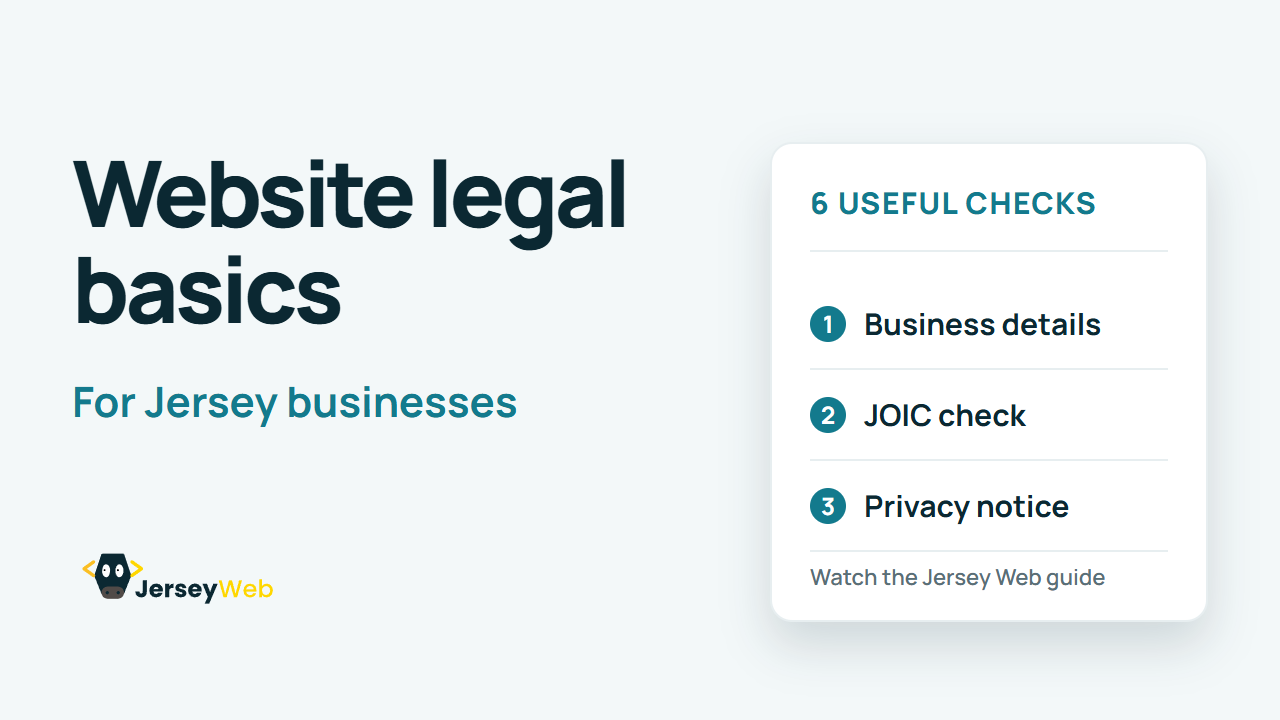
1:47 · No narration: the video shows each step as text on screen, and every step is written out below, with buttons that jump the video to it.
Prefer YouTube? Watch this video on our YouTube channel (opens in a new tab).
This video goes with our guide What a Jersey business website has to show, which has the full detail.
The 6 checks in the video
The video opens with a question: what should a Jersey business website show? The legal basics are easy to miss, so it gives visitors the right information in six checks.
-
Step 1: Identify your business
Make it clear who runs the website.
Show your business name and a contact route a real person answers, usually in the footer of every page. If you trade as a limited company, use the company name. A visitor should never have to guess who they are dealing with.
If you sell at a distance, this is also a legal point. The Distance Selling (Jersey) Law 2007 (opens in a new tab) lists your identity among the things a consumer must be told before they buy, and your address as well when they pay in advance.
-
Step 2: Check JOIC registration
Review your data protection obligations.
Every controller or processor established in Jersey that processes personal data must register with the Jersey Office of the Information Commissioner (opens in a new tab) (JOIC), unless an exemption applies. The duty comes from the Data Protection Authority (Jersey) Law 2018, and failing to register is a criminal offence. A contact form that collects names and email addresses is processing personal data, and so is a customer list.
The JOIC’s registration page lists a charge of £70 a year for organisations with fewer than ten full-time equivalent employees, sole traders included. Once you’re registered, your name, registration number and expiry date appear on the public registry (opens in a new tab), so you can put the number in your footer for customers to check.
-
Step 3: Explain your data use
Say what information you collect and why.
The Data Protection (Jersey) Law 2018 (opens in a new tab) says people must be given certain information when you collect their details: who you are and how to contact you, why you want the data and your legal basis, who receives it, how long you keep it and what rights they have. On a website, that information lives in a privacy notice, linked from your footer and from every form.
Write it for your own business. A notice copied from another site often lists tools you don’t use and misses the ones you do. The JOIC’s advice for new businesses (opens in a new tab) points to its own privacy policy template.
-
Step 4: Control tracking
Check consent before non-essential tools load.
Analytics, advertising pixels and some embedded media can collect personal data about your visitors, which brings them under the Data Protection (Jersey) Law. Where you rely on consent, the law defines it as a freely given, specific, informed and unambiguous indication, given by a statement or a clear affirmative action. A pre-ticked box, or a banner that appears while tracking is already running, is hard to square with that.
The practical test: open your site in a private browser window and check that nothing non-essential loads before the visitor says yes. Then list each tool in a cookie policy, with what it does and who provides it.
-
Step 5: If you sell online
Show the terms customers need before checkout.
Under the Distance Selling (Jersey) Law 2007, a consumer buying at a distance must be told, in good time before they buy, who you are, the main features of what you sell, the price including all taxes, any delivery costs, how payment and delivery work, and whether they have a right to cancel.
For goods, the cancellation period normally ends 7 working days after the customer receives them, once you have sent the written confirmation the law requires. Goods should arrive within 30 days unless you agree another date, and refunds are due within 30 days of a cancellation. Trading Standards’ guide (opens in a new tab) lists the goods with no right to cancel, such as personalised items and perishable goods.
-
Step 6: Make access easier
Build pages people can read and use.
The Discrimination (Jersey) Law 2013 (opens in a new tab) doesn’t mention websites, but it covers disability in the supply of goods, facilities and services. Failing to take reasonable steps to avoid putting a disabled person at a substantial disadvantage counts as discrimination under it.
The recognised standard to build to is the Web Content Accessibility Guidelines (WCAG) at level AA. In practice that means text with enough contrast, alt text on images, forms with proper labels and pages you can use with a keyboard alone. Our website accessibility guide goes through the fixes.
General information, not legal advice
We build websites; we aren’t lawyers. This page summarises the Jersey laws a small business website usually touches, checked against jerseylaw.je, the JOIC and gov.je in October 2026. Your own situation may differ, so for anything unusual speak to a Jersey lawyer, or call the JOIC on 01534 716530 with data protection questions.
Two more points the video has no time for
- What you sell has to match what you say. The Supply of Goods and Services (Jersey) Law 2009 (opens in a new tab) says goods sold in the course of business must match their description and be of satisfactory quality, and services must be carried out with reasonable care and skill. So describe your products accurately.
- Based outside Jersey? JOIC registration follows where you are established. The Data Protection (Jersey) Law 2018 still applies to an organisation outside Jersey that offers goods or services to people in Jersey, so the privacy notice and consent points above apply to you too.
Common questions
Do I need to register with the JOIC if my website only has a contact form?
Almost certainly. Every controller or processor established in Jersey that processes personal data must register unless an exemption applies, and a form that collects names, email addresses or phone numbers is processing personal data. Failing to register is a criminal offence.
How much does JOIC registration cost?
The JOIC’s registration page lists £70 a year for organisations with fewer than ten full-time equivalent employees, including sole traders, £90 for 10 to 50, and £500 for more than 50. Some financial services businesses pay extra charges on top.
Does a Jersey business website need a cookie banner?
If your site runs analytics, advertising or other non-essential tools that collect personal data, the Data Protection (Jersey) Law 2018 applies to them. Asking for clear consent before they load, and explaining each tool in a cookie policy, is the safe approach.
What must a Jersey online shop tell customers before they buy?
Under the Distance Selling (Jersey) Law 2007: who you are, your address if they pay in advance, the main features of what you sell, the price including all taxes, any delivery costs, how payment and delivery work, and whether they have a right to cancel.
How long do customers have to cancel an online order in Jersey?
For goods, normally 7 working days after the customer receives them, once you have sent the written confirmation the law requires. If you never send it, the period runs much longer. Personalised and perishable goods are among the exceptions.
Is website accessibility a legal requirement in Jersey?
The Discrimination (Jersey) Law 2013 doesn’t mention websites, but it covers disability in goods, facilities and services, including a duty to take reasonable steps to avoid putting disabled people at a substantial disadvantage. WCAG level AA is the recognised standard to build to.
Go further
More video tips
All 205 videos →
Selling online from Jersey: six checks before your shop goes live
Six checks for a Jersey online shop that sells to islanders and to the UK.
Starting a business in Jersey: from registration to website
Six stages from business idea to first website, in the order Jersey needs them.