URL Percent Encoding Explained: Why Website Addresses Can Contain %20
Why does a copied website address sometimes contain percent signs? Percent encoding represents certain URL characters using encoded byte values.
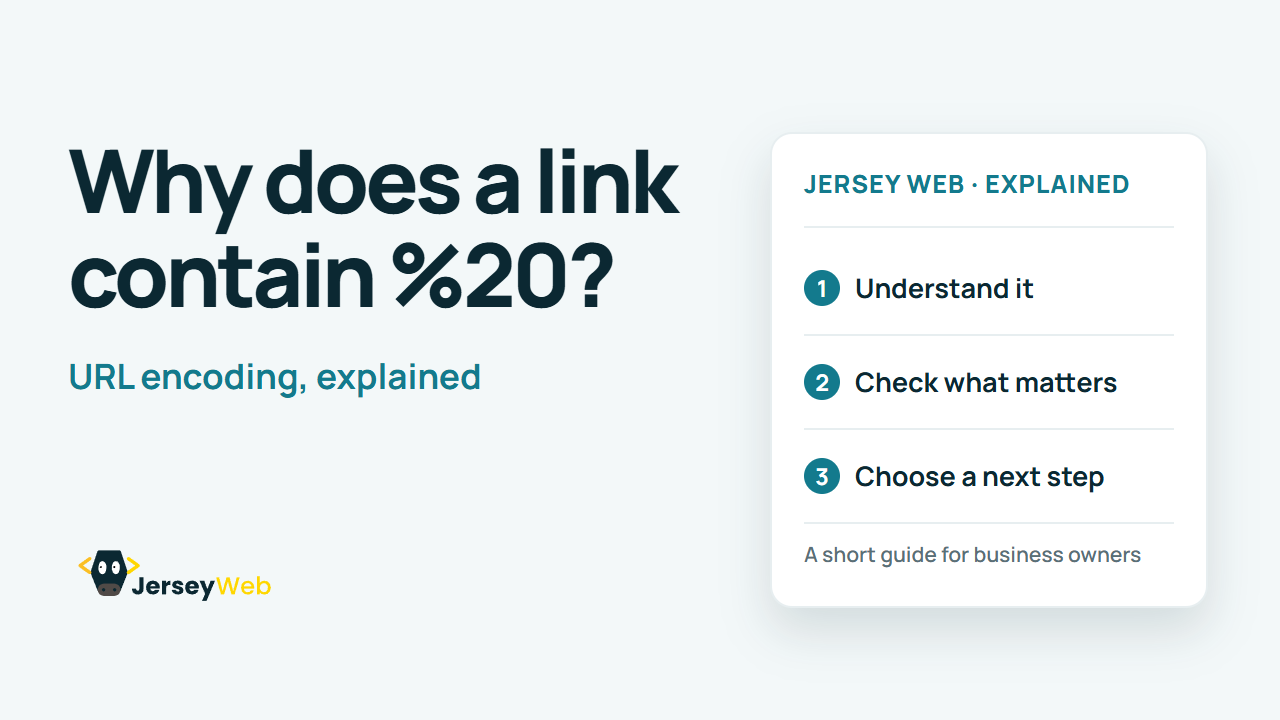
1:47 · No narration: the video shows each step as text on screen, and every step is written out below, with buttons that jump the video to it.
Prefer YouTube? Watch this video on our YouTube channel (opens in a new tab).
The six points in the video
This is a silent video. The headings, explanations and labels below reproduce the information on screen.
-
Step 1: Recognise the percent pattern
A percent sign followed by two hexadecimal digits represents an encoded byte.
On-screen labels: Percent sign; Two hexadecimal digits; Encoded byte.
-
Step 2: A space can become %20
Space handling depends on the URL or form-encoding context.
On-screen labels: Space character; Percent-encoded space; Encoding context.
-
Step 3: Some symbols are separators
Characters such as question marks and ampersands can have structural roles.
On-screen labels: URL structure; Reserved symbol; Component meaning.
-
Step 4: Encode values appropriately
A value containing a reserved symbol may need encoding within its component.
On-screen labels: Individual value; Correct component; Preserved meaning.
-
Step 5: Avoid encoding it twice
An already encoded percent sign can be encoded again and change the result.
On-screen labels: Original value; Existing encoding; Unexpected double encoding.
-
Step 6: Check the resulting link
Use suitable URL tools and verify the page receives the intended value.
On-screen labels: Generated address; Expected value; Correct destination.
A practical check for your business
Use the appropriate URL-building tools when adding values to an address. Test spaces, symbols and non-ASCII text so the received value matches the intended input without accidental double encoding.
Sources and further detail
Common questions
Why does a copied website address sometimes contain percent signs?
Percent encoding represents certain URL characters using encoded byte values. Use the right URL tools and test the resulting destination.
Go further
More video tips
All 205 videos →
Restaurant Website Checklist: Help Guests Choose, Find and Book You
Restaurant and café website checks.
Charity and Club Website Checklist: Help People Join In and Find Support
Charity and club website checks.