Watch a related explainer

In plain English
Bandwidth describes how much data a communication link can carry at a given rate. Cloudflare’s network-quality explanation distinguishes capacity from the other measurements involved in a connection. A capacity figure is useful, but it is only part of the description of a working website task.
Throughput is the rate actually achieved over the measured interval. Latency is delay. IBM’s latency overview explains these distinctions and the units used for network capacity. When someone calls an Internet connection fast, ask which measurement they mean and how it relates to the activity that is causing difficulty.
Providers can also use bandwidth in a proposal to refer to a total data-transfer allowance over a billing period. Ask for the quantity, units and applicable limits. A monthly allowance and a rate expressed per second answer different questions, even if both appear under the same informal label.
Why it matters for a Jersey business
A business owner may see a high connection figure while a website still feels slow. The task could involve an office network, a remote server and application processing. The useful next step is to describe what is slow and where, so the responsible people can review relevant evidence instead of changing a specification without understanding the problem.
This also matters when comparing hosting arrangements. An allowance in the service agreement can affect operational planning, while actual page performance needs its own review. Keep the provider’s limits and the customer’s experience distinguishable in the handover.
A realistic Jersey example
Imagine a Jersey retailer reporting that product images load slowly on an office laptop. This is a hypothetical example. The team records the page, device, connection and time. It checks the relevant image delivery and asks the network maintainer to review the office connection under an agreed scope.
The team does not assume that the advertised capacity identifies the cause. It examines the measured task and any relevant difference under comparable conditions. If an improvement is made, it checks that the product information and images are usable afterwards. No numerical result or customer outcome is claimed for this example.
Practical checks before changing capacity
Name the activity. Record whether the problem affects a page load, file upload, download or interactive feature. Describe the expected outcome and what the user actually experiences. The same connection can support different tasks with different requirements, so a vague report that the Internet is slow needs practical context.
Record the measurement conditions. Identify the device, connection type, destination and relevant time. A speed-test result measures a particular interaction with its test service. It does not automatically describe every remote application. Retain enough context for the administrator to interpret the result alongside the website symptom.
Review other quality measures. Cloudflare’s measurement documentation includes latency, packet loss and jitter alongside transfer measurements. The exact method and scenario matter. Use the relevant results to support diagnosis instead of treating a download number as a complete assessment of the connection.
Ask where the constraint occurs. A task can depend on the local network, external route, application or a connected service. The responsible maintainer should examine the relevant path and evidence. A resource increase is useful only when it addresses the issue identified for that task.
Check provider terminology. If the proposal mentions a transfer allowance, ask what traffic counts and how the service handles the stated limit. Keep the explanation tied to the actual agreement. Do not turn an informal label into a claim about unlimited capacity or an automatic performance guarantee.
Review the result after a change. Use a comparable task and record the conditions. Confirm whether the symptom improved and whether the required information or operation still works. This is stronger evidence for the business than a larger specification appearing on an invoice.
Common myths and mistakes
Bandwidth is not a complete website-performance score. Delay, loss and application behaviour can affect a task even when a link has substantial capacity. Keep the diagnosis connected to the observed problem rather than assume that more capacity repairs every slow interaction.
A single speed test also does not prove that the website host is at fault or that the office connection is healthy under every condition. Record its scope and compare it with relevant evidence from the actual service path.
Our take
Use bandwidth as a specific capacity term. Clarify the units, distinguish the measured rate and delay, and check the business task before choosing a change. That makes a performance conversation easier to act on and review.
A real Jersey example
Image files contribute to transferred data
These versions of a St Catherine’s waterfront photograph contain different amounts of data. Choosing an appropriate source can reduce the image bytes a visitor receives. The file sizes below are actual binary sizes; they do not include the rest of the page, protocol overhead or repeat visits served from a cache.

Actual delivery files
| Pixels | File size | Preview |
|---|---|---|
| 480 × 360 px | 14.0 KiB | Open 480 px export |
| 960 × 720 px | 46.6 KiB | Open 960 px export |
| 1600 × 1200 px | 108.5 KiB | Open 1600 px export |
| 1920 × 1440 px | 140.9 KiB | Open 1920 px export |



These are delivered file sizes, not a prediction of loading time or a like-for-like format benchmark.
Browse the original Jersey photo library → · Check photo usage terms
See it in a diagram
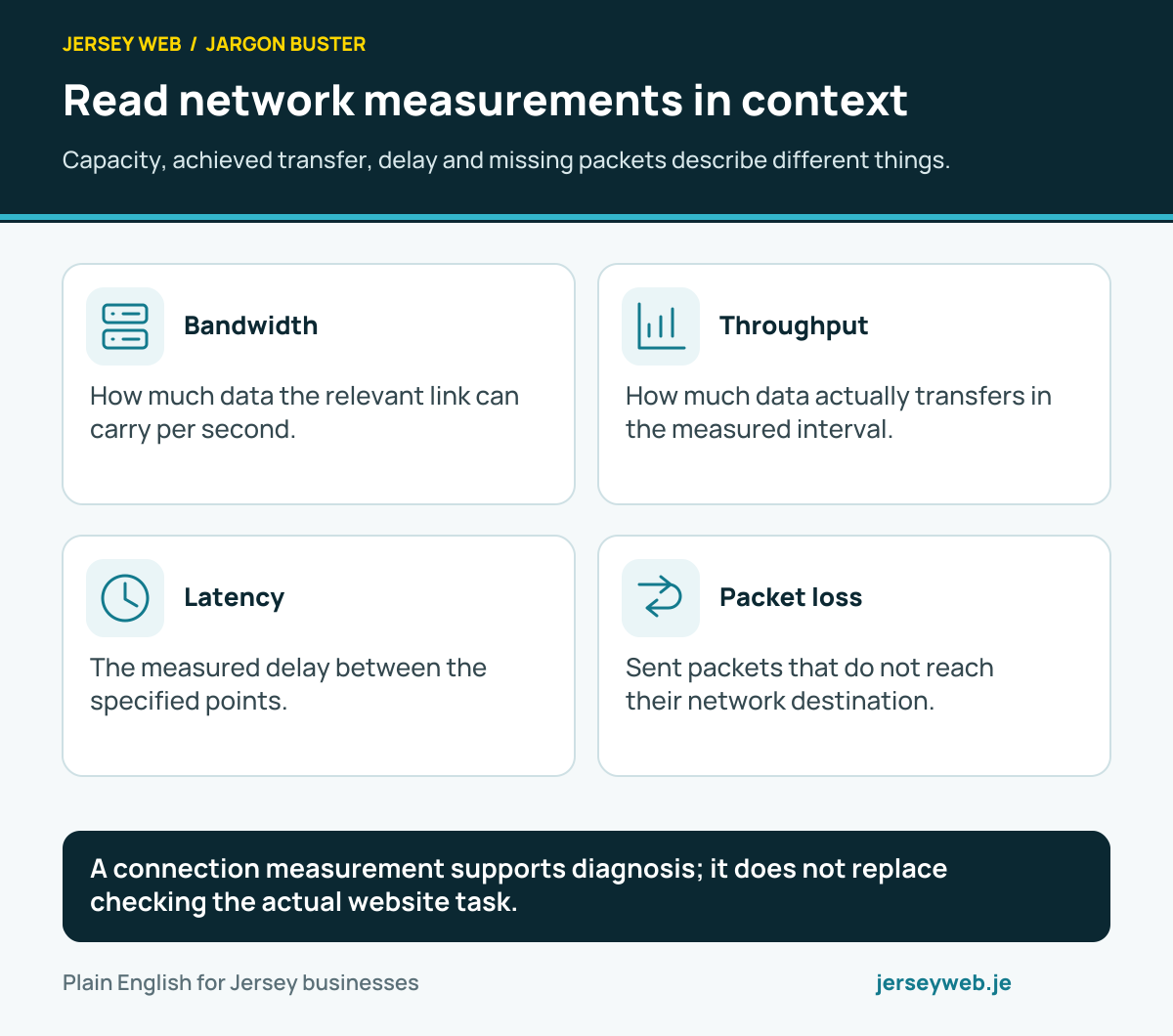
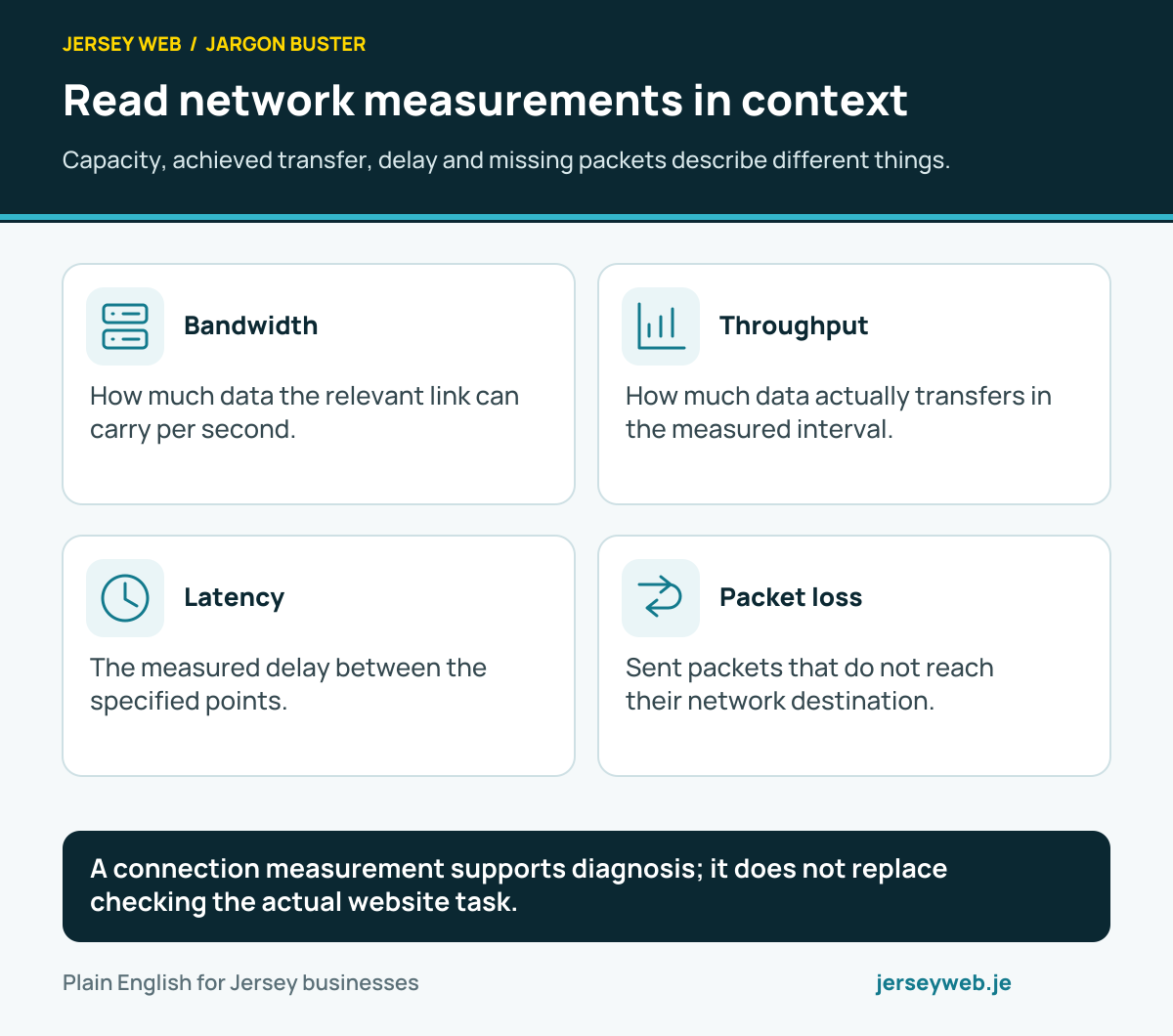
A connection measurement supports diagnosis; it does not replace checking the actual website task.
Read the diagram in text
- Bandwidth. How much data the relevant link can carry per second.
- Throughput. How much data actually transfers in the measured interval.
- Latency. The measured delay between the specified points.
- Packet loss. Sent packets that do not reach their network destination.
Related terms
Learn more
Common questions
- Is bandwidth the same as download performance?
- Bandwidth describes capacity, while measured throughput describes an achieved transfer rate. Other network and application factors can affect the result.
- Is bandwidth the same as latency?
- No. Bandwidth concerns transfer capacity. Latency concerns delay. A connection can have substantial capacity and still have delay relevant to an interactive task.
- Will more bandwidth always make my website faster?
- No. A particular task may be limited by another network condition, application processing or page construction. Review the actual bottleneck before choosing a change.
- What if a hosting plan uses bandwidth to mean a monthly allowance?
- Ask the provider which quantity and units it means. A total transfer allowance over a period is different from a connection’s transfer capacity per second.
Written by Jersey Web. Last reviewed 12 October 2026. Back to the Jargon Buster.